
April 21st 2019
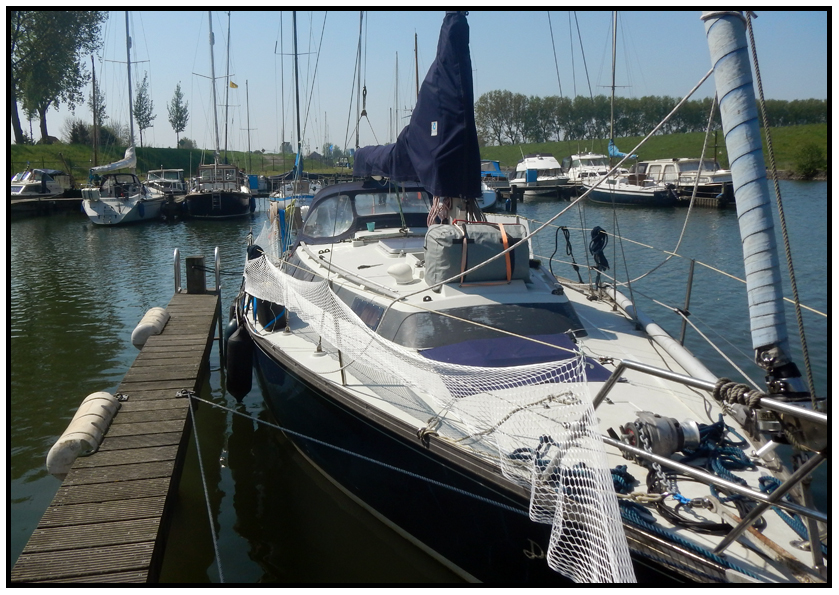
Another sunny and warm day, a perfect day to work on the safety net for Captain Fluffy. We unrolled the net we had bought and fastened it in a makeshift manner to the sea railing to see if we had enough and how we would attach it permanently.
By doing this we encountered 2 problems. The first one was that part of the net had to be removable, so that Captain Fluffy could jump on and off when we are in a marina. The second one was how to deal with the jib sheet. The line now crosses underneath the sea rail into the genoa track. But if we would fasten the net, the sheet had to run through or under the net, both not very desirable options. We couldn’t think of a sensible solution, so in the end we decided to tackle project safety net another time, and check out how other people have done it first.
On to the next task then, cleaning the water tank. Not that complicated, just put some food grade oxi (Sodium percarbonate) in your tank, fill her up and wait for 30 minutes. Then empty the tank, fill her up again and empty again. Jeroen got the idea to clean the bilge at the same time, something we still had to do if you remember that the bilge pump went completely berserk 2 weeks ago. We have a foot pump to operate the water tab, and emptying the water tank takes ages this way. But by disconnecting one of the hoses that run from the tank to the tab, the water -with the Sodium percarbonate- runs into the bilge minimizing our effort and cleaning the bilge at the same time!

Then there was another chore that needed to be done. A very scary one. We had noticed that the display wasn’t giving any readings of our speed. We hoped that with a few days sailing the moss or whatever was stuck to the transducer would dissolve or something, but it didn’t. The only thing left now is to pull the transducer out of its socket and clean it manually. The scary part of this story is that once you pull the transducer free from its socket, you basically create a 4 centimeter diameter hole in the bottom of your boat below the waterline. That means water will come gushing in. Now you have a sort of plug that you need to shove in the hole immediately after removing the transducer, but it is still rather scary to make a hole in your boat on purpose while it’s in the water. After cleaning the water tank and the bilge we knew for certain that the bilge pump was working, so after few deep breaths it was time to pull the plug. The water started to squirt out the small gap, when the transducer was unscrewed which was rather alarming, but when the whole thing was out of its socket it went more like …gloop…gloop…gloop. It wasn’t gushing in like we were expecting. Of course you shouldn’t put on a kettle to make tea after you have unscrewed the transducer, but there’s enough time to push in the plug and screw it down. As it turned out a family of tiny shrimps and some small mussels had made the wheel of the transducer their home. Sorry guys, but it’s time to relocate. We gently pried them loose and released them in the water again. A quick scrub, and the transducer was ready to be plugged back. It all turned out to be not that scary as we were expecting.

We also installed a new lamp at the chart table, so the to-do list is definitely shortening. That is, if you’re ever done with chores on your boat.
We concluded our last day here sampling some home-made beer and cider with our harbour masters Arthur and Saskia on their boat and shared more adventures. They told us about how they ended up as captain and host on a 80 foot classic charter yacht, the Vixen II, in the Mediterranean and how they participated in regattas like the Ibiza Gold Classic with this majestic ship (see movie). It was great to have met this inspiring couple.
Tomorrow we’re leaving to test out our anchor for the first time!