The fine art of stowing many things in a few small spaces.
April 6th 2019
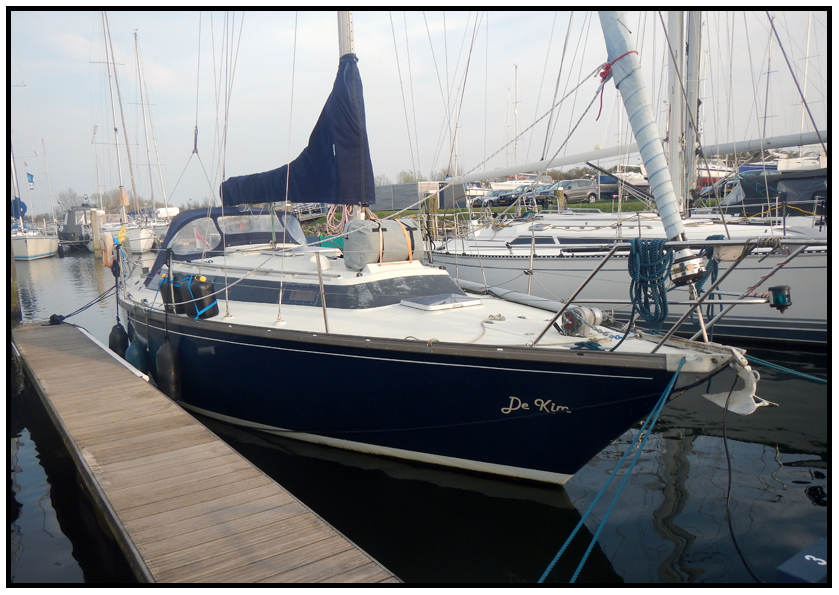
Ready to leave and on same level as the waterline
The last shoppings. Filling up the diesel tank, getting the last fresh groceries like fruit and vegetables. Also some last minute chores: washing the exterior of the boat, placing the EPIRB, fitting a separating board in the locker underneath the couch so that the cans with food stay where they are.
Today we really had to empty the small storage we rented at the marina, where we kept our tools and other stuff you don’t need everyday. It is rather discouraging to look at the pile of stuff that still needs to find its way into the boat knowing that it’s already filled to the brim.
Fitting everything into our boat was like a big 3D-jigsaw puzzle. We probably re-arranged every locker about 3 times. And the boat needs to be balanced out as well, you can’t just chuck all the heavy things in one locker because they fit so snugly. The weight has to be distributed equally between port and starboard and between bow and stern.
Two o’clock in the morning we were finally done. We now carry so much weight that the water line on the hull is exactly on water level.
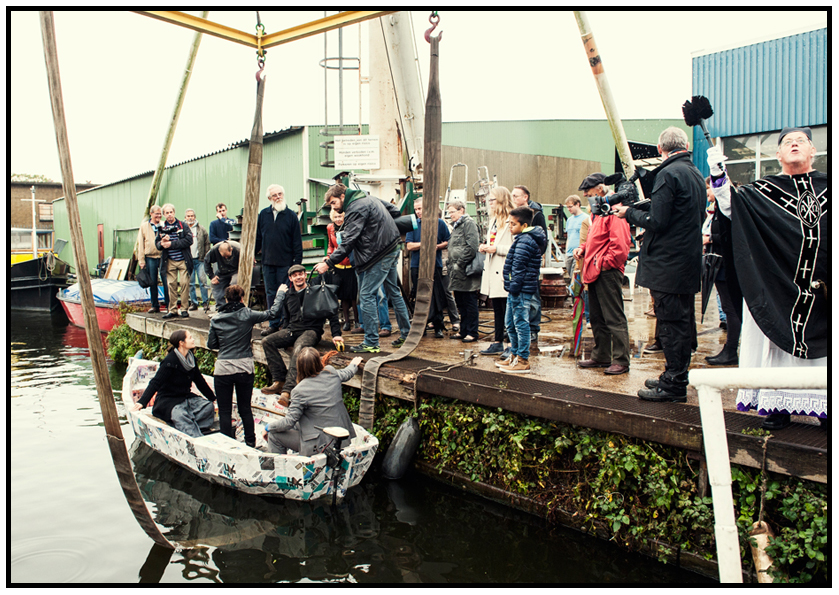
The launch of our paperboat ‘Binckie’ at shipyard De Haas in 2014
Not much time today for boat chores. Going away for a long time also means saying goodbye to a lot of people. So today is all about saying goodbye.
We went to the ship yard where we built our last paper boat as part of an art project in which we made boats from paper. In the beginning the idea was to make paper boats and make movies in which we try to sail in them, but fail abysmally because our boat would obviously sink. As everyone knows you can’t float in a paper boat. But the third boat wouldn’t sink anymore, so the project evolved from tragic soggy failures to paper boats made with biodegradable glue that were actually sea worthy, but would disintegrate after a few weeks. The first boats we built in our living room, but then we were asked to built one that could serve as a ferry during an art festival, the I’M Binckfestival in The Hague. We couldn’t build this one in our living room anymore, because it had to be a lot bigger and carry more people than just the two of us. That’s how we met Jos and Roel de Haas. They run shipyard ‘de Haas’ and kindly let us build our boat there. Binckie, as our boat was called was 5 meters long, 2,5 meters wide and could carry up to six adults. Thanks to the care and devotion of Jos and Roel, Binckie didn’t survive a few weeks but a few years and all the time he found shelter at the ship yard until he was eventually sold to a event bureau.
The shipyard was founded by Jan de Haas senior in 1921 and almost a century later it is run by Roel de Haas, the fourth generation in line. Roel and Jos (his father and former owner, officially retired but nevertheless still every day at work at the yard) are wonderful people. During our paper boat project we’ve gotten to know them as warm, resourceful and helpful people. And we still come there often, not only for repairs now we have a ‘real’ boat, but also for a chat and a cup of coffee. Today we brought them home made loempias, an Indonesian snack to which Roel’s stepdaughter is particularly partial, as a saying goodbye gesture.
Some of the regulars who have been coming there for decades had been to the Baltic Sea before and provided a lot of last minute advise. That’s what makes this place so special, the comradery of the people that come here.
The last exchange of email addresses, the last goodbyes and back to Stellendam. Busy day again tomorrow.
The moment of truth; will the new boards and the mattresses for the v-berth fit? Drumroll please…
Yes, it all fits! Pff, such a relief that we do not need to adjust them again. Bed mattresses are quite big and a pain to handle. The only thing we need to do now to successfully wrap up this project is to hand-stitch the cushions to close them. One done, three more to go.
On to the next project: the solar panels. We bought two 100 watt panels optimized for our northern latitudes where the sun is known not to make a regular appearance. We want to attach them to our life lines at the side of the cockpit, but unfortunately our panels didn’t came with holes. And it’s quite scary to drill holes in your brand new – and not exactly cheap – solar panels. Plan is to drill holes, fit them with grommets and use carabiners to hang them from the life lines. After gathering courage Jeroen finally drilled the first hole and pounded in a grommet. Looks promising!
But due to a sudden hailstorm we had to postpone the drilling exercise. More luck tomorrow.
Today is the start of a new adventure. No, this is not an April fools’ day joke. We’re about to go on a trip with our sailboat to the Baltic Sea. The idea is to visit all the 10 countries that border the Baltic Sea in 6 months. But this plan is not set in stone. If we won’t get any further than the north of the Netherlands it’s just as fine. It’s all about the journey, isn’t it?
We will start out by sailing north via the ‘Staande mast’ route (Fixed mast route) through the Netherlands. That way we can get used to travelling, fix whatever is necessary to fix along the way before we’ll get to the Baltic Sea and see a part of the Netherlands we haven’t seen before.
And it’s a good thing that we aren’t on a tight schedule because we are already delayed before we have even started. It is said that chores on a boat always take longer than anticipated. Our chores form no exception to the rule, hence the delay.
Before the big trip we had to do some necessary repairs and chores. Especially since we still have a small storage here at the marina and a place to work on bigger projects. One of those projects was a complete refit of the v-berth. Condensation is always an issue in a polyester boat, so we had to make some adjustments to keep the moisture at bay. We sawed new boards for under the mattresses with big holes in them to enable air circulation underneath. The varnish is drying nicely, tomorrow the boards will have fully cured.
The mattresses themselves needed to be replaced as well. We had done the settee and the chart table cushions a year ago, but somehow didn’t find the time to do the v-berth as well. Making cushions is not that difficult, especially if you have the old cushions for tracing the shape. The thing to keep in mind is that you need to cut the foam one centimetre bigger than you measure, and later on the fabric one centimetre smaller than the foam. And don’t forget the seam allowance when cutting the fabric of course.
Thus we ordered big blocks of foam and cut the shapes for the cushions with an electric bread knife. The perfect tool for the job. We also bought the fabric for the new upholstery and cut that out as well. No, not with the bread knife. Just regular scissors this time. It was very convenient that we were still in our marina. The central area of the sanitary space is so big -and relatively clean- that we could lay the foam and the fabric on the floor and cut everything there.
After sowing the pieces of fabric together, one of the covers wouldn’t fit so we had to redo that one today. Tomorrow we’re going to try and fit the boards and cushions into our v-berth, hopefully they’ll fit. Fingers crossed…
The final departure date is now set on Sunday the 7th at the latest.