Singing frogs

Anchoring at the IJsseloog

June 16th 2019

Enkhuizen Oosterhaven to anchorage IJsseloog: 21,6 nautical miles

It is time to leave. Water tank all filled up, everything secured, okay…off we go. We hailed the harbour master that we were about to leave and asked him if he would be so kind to open the bridge for us. “Are you wearing your glasses this time?” he answered. Hmmm…apparently it is still the running gag.

We’re never quick to leave, and it was already past one o’clock in the afternoon. We wanted to sail to the IJsseloog, what is famed to be the most beautiful anchorage in the Netherlands. But according to our navigation app it’s almost 6 hours sailing, so maybe it’s already running a bit late to make that passage. 

We decided to see if there was an empty spot to anchor at the Zuiderzee Museum where we had anchored a week ago, and leave early tomorrow morning. So we turned to port right after we left the municipality marina, to enter the sheltered anchorage near the museum. It was a bit crowded, but it seemed like there was still a spot where we would be able to squeeze in. It was quite shallow but just do-able, so we dropped the anchor, let out more chain and slowly moved backwards. When the anchor had dug itself in, we surveyed our location. We were too close to the boat behind us, at least in our opinion. The guys on the boat didn’t even bother to look up. No…definitely too close, so we hoisted the anchor again and went in search for another spot. The only other spot left available was really too shallow for us. Apparently the universe thinks it’s time to leave Enkhuizen. It is saying “Leave now or stay forever!”.

We decided to go to the IJsseloog anyway despite the fact that in the meantime it was already was 2 o’clock in the afternoon. We could always find refuge in Urk we reasoned, which would shorten the trip with 2 hours. But the wind was stronger than forecasted thus the passage also was swifter then we had anticipated. We were soaring along with an average speed of 5,5 knots. It was almost a downwind sail, so we didn’t even have to tack for 3 hours.

Jeroen at the helm

The only obstacle we had to negotiate before we would reach our destination was the Ketelmeer bridge. Unfortunately we had just missed the opening and had to wait for 30 minutes. We needed to lower our sails before we could pass the bridge. Heading downwind means you end up at the lee shore. That means that all the water is blown towards that side of a lake, and with these winds it was causing quite steep waves. So steep in fact, that the boat was rocking violently back and forth like a see-saw when we were heading straight into the wind to lower our sails. The nose disappeared into the waves every time the boat rocked forward. Jeroen had to hang on for dear life not to be thrown overboard when he was lowering the main sail.

Weird, once we passed the bridge the wind and the waves were gone. We initially hoisted the sails again, because we still had 90 minutes to go to before we had reached the island. But there just wasn’t any wind anymore. Only because of that one bridge we went from 6 knots to 1 knot speed. It was already 5 o’clock and we were getting tired. Since we didn’t feel like slowly bobbing forward we reluctantly started the engine.

After an hour motoring we arrived at the mooring spot at the IJsseloog. It was beautiful! Big trees, birds singing everywhere and luckily not too crowded with other boats. The IJsseloog is an artificial island in the Ketelmeer. The island functions as a depot and cleaning station for polluted silt. The depot in the middle of the island where the silt is stored is sealed thoroughly, so that no pollutants can enter the surrounding water. The outer rim of the island is designed as a recreational zone, with a protected channel where boats can anchor.

We saw a spot where we wanted to anchor. A quick peek on the navigation app assured us that it was 2,5 meters deep there, so we should be alright. But when we moved towards that spot we saw the depth rising fast to 1,4 meters! We’re stuck! Bit of wriggling and we were free again, so we quickly moved on and tried to anchor somewhat further. We dropped the anchor, slowly backed away until the anchor was set. We surveyed our surroundings and saw thick bushes of water plants below the surface. “Maybe the plants cause the depth meter to measure 1,4 meters. But isn’t that the ground we see there?” A bit of poking with the hook told us that what we saw was indeed the ground and we were stuck, again. We couldn’t even move the rudder.

We started to haul in the chain to tear ourselves loose again, which fortunately worked. Not trusting the map anymore we cautiously explored the other side of the small channel, and discovered that the depth was better there. We threw the anchor in again, and this time we had more luck. 
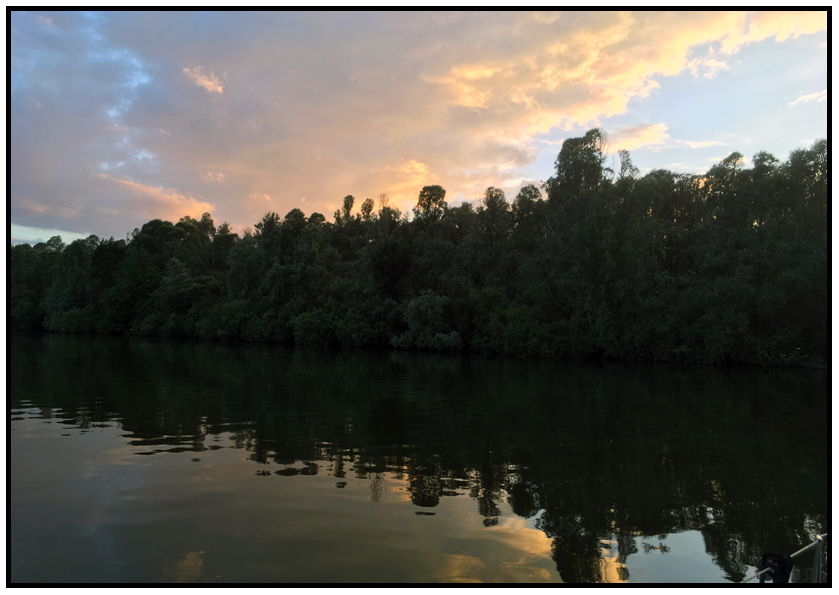
Our view on the setting sun

After a tiring day we settled down in the cockpit. The scenery is truly beautiful. It doesn’t look like we’re in the Netherlands anymore and somehow were magically transferred to a picture from a fairytale book. We spend the evening till darkness fell in the cockpit to watch the sun set with a backdrop of twittering birds and singing frogs.
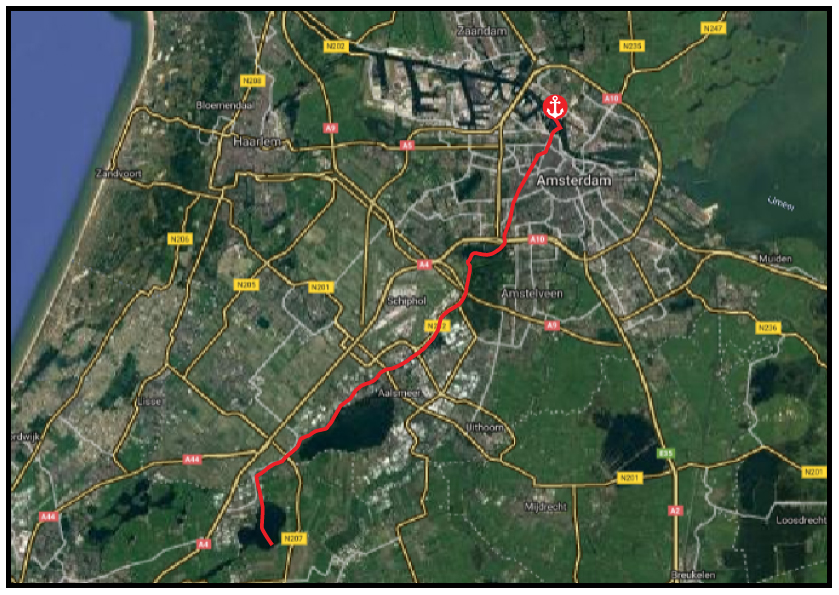
Our first nightly passage

Passing through Amsterdam in the dark

May 8th 2019

Anchorage Braassemermeer to Amsterdam: 18 nautical miles

We were rudely awakened this morning by a clashing sound, followed by the anchor alarm going off. Apparently we were dragging, so we jumped out of bed to check on the anchor. We had indeed been dragging, but fortunately not much. But the wind direction had shifted and a quick check on the weather forecast told us that the wind would turn 180 degrees and increase to wind force 5 when a thunderstorm would pass over. Yesterday when we checked the weather forecast the wind would continue to blow from the east, and although rain was predicted, nothing was said about thunder and lightning. Well, you know what they say, nothing as unpredictable as the weather. No wonder our anchor was dragging. It probably didn’t have any grip in the slushy peat bottom.

What shall we do now? Reset the anchor or continue to Amsterdam? The next stage would lead us to the Nieuwe Meer lock, the start of the nightly passage. But then we would have to leave within 15 minutes otherwise we would miss the bridge opening over the A9 motorway near Schiphol at 12.30 hours. We had planned to stay here for 2 or 3 days so we weren’t expecting to be faced with this decision right now. Choices, choices. And we had to decide quickly, because we were still dragging. And all that on an empty stomach and without a drop of coffee.

We made the decision to hoist the anchor and continue to Amsterdam. We quickly put on our sail gear -in the meantime it had already started to rain- pulled the anchor out of the sludge and continued to Amsterdam.

We past another big stretch of water, the Westeinderplassen. Initially we wanted to anchor there as well, but the whole lake is even more shallow than the Braassemermeer. And we didn’t feel like repeating yesterday’s close encounter with the ground again. But definitely a beautiful place to go to if you have a boat with less draft. This lake and the Braassemermeer, where we were yesterday, all used to be peat bogs. After they had dug out the peat these lakes with their tiny islands and small drainage canals were left. You can moor between the high reeds or at the tiny islands. But alas, not for us. Onward we went through the drizzling rain.

Suddenly the depth meter jumped from 2,5 to 1,4 meter! A submerged bump in the waterway! The boat lurched back and then catapulted forward like we were being launched over a ramp. These are truly the days of insufficient depths…

We made it in time for the bridge opening at the Schipholbruggen. These bridges only open 3 times a day due to the busy traffic, so you really don’t want to miss an opening. We even had 20 minutes to spare so we tied up to the waiting dock and made a cup of tea. After the bridges we entered the Nieuwe Meer. The idea to anchor here for a day or two before the night passage through Amsterdam, was cut short. According to the signs we weren’t allowed to anchor here anywhere. That meant we had to do the passage tonight, something we hadn’t anticipated. But as it seemed, nothing went according to plan the last few days. So we tied ourselves to the waiting dock, and tried to catch some sleep before the passage. 

Waiting for the bridges and lock to open at 23.56h

When we arrived at the waiting dock we had hailed the control center to state our intention to pass trough Amsterdam with the night convoy. We were given the instruction to listen to channel 69 for further instructions from 23.00h onwards, because the passage would start at 23.56h. Thus after a late dinner we waited for the instructions. But the channel stayed silent, so we hailed them again. Finally a response. The bridge opening would be at 23.55, so we had to be ready in front of the bridge at 23.50 because they had to open 2 motorway bridges and 3 train bridges in one go, which we had to pass within a few minutes. They would hail us for further information.

So we untied at 23.48 and drifted towards the bridge. Silence. Nothing to be heard on the VHF. Finally at 12.10 the bridge started to open and we could pass on to the lock that lies directly behind the 5 bridges.

In the lock we had a few minutes to fully appreciate that we had started our nightly adventure. We were rather nervous since we had never done a night passage before, let alone one through a city notorious for bicycles littering the canal floors, with 15 bridges and one lock.

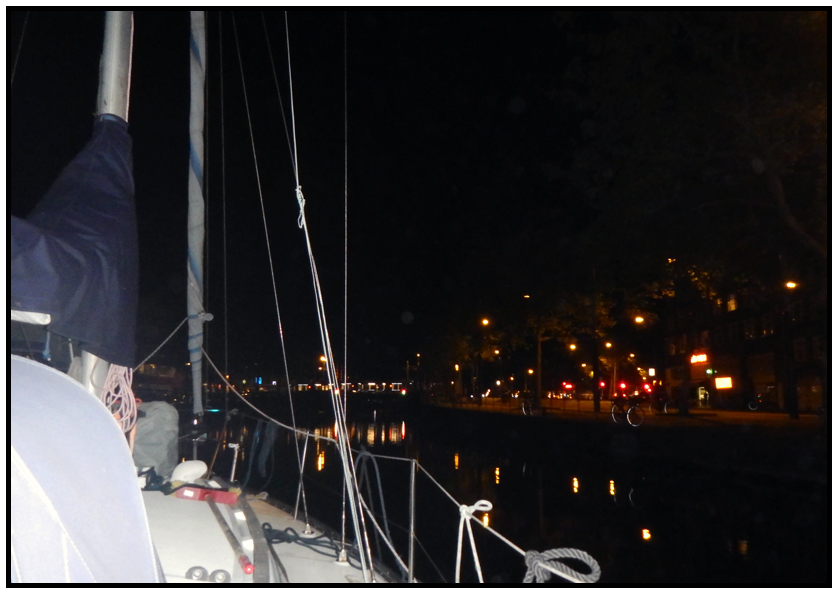
It was almost new moon, and when we left the lock it was pitch dark. Later on when we entered the inner city it became a lot brighter with all the street lighting, neon signs and illuminated windows. Slowly our nervosity subsided. It was actually all rather exiting. We were very much focused not to hit anything in the dark like the aforementioned submerged bicycles and to time our arrival at the bridges, but all in all we were able to enjoy the passage. Turned out the whole convoy was just us, and the bridges were operated remotely, so all alone we went through the dark canals of Amsterdam.

The nightly passage through Amsterdam

The 14th bridge was another rail bridge. We were supposed to hear the exact time of passage over the VHF, but there was only silence. After 15 minutes we hailed them, and were told that an opening would be arranged shortly. Shortly in Amsterdam apparently means something else than in the rest of the world, because we had to wait for another 20 minutes before the bridge opened.

One last bridge and then we entered the IJ canal, a broad water channel connecting the North Sea with the IJsselmeer. The marina where we were heading was on the other side of the canal, slightly to the left. Leaving all the bright city lights behind us, it became pitch dark again. There was a near miss with a lock pilar in the dark, and we had to maneuver around big wooden dolphins (sort of docking blocks sticking out the water). Normally they have white caps, but these didn’t, rendering them virtually invisible in the dark.

The IJ canal luckily wasn’t busy at all. We saw one other vessel in the distance, so we could safely cross to the other side and enter the marina.

It wasn’t long before we were safely moored in Amsterdam marina. But it took a while before we could sleep with all the excitement of completing our first night passage.

Stuck in a peat bog

Anchoring at the Braassemermeer

May 7th 2019

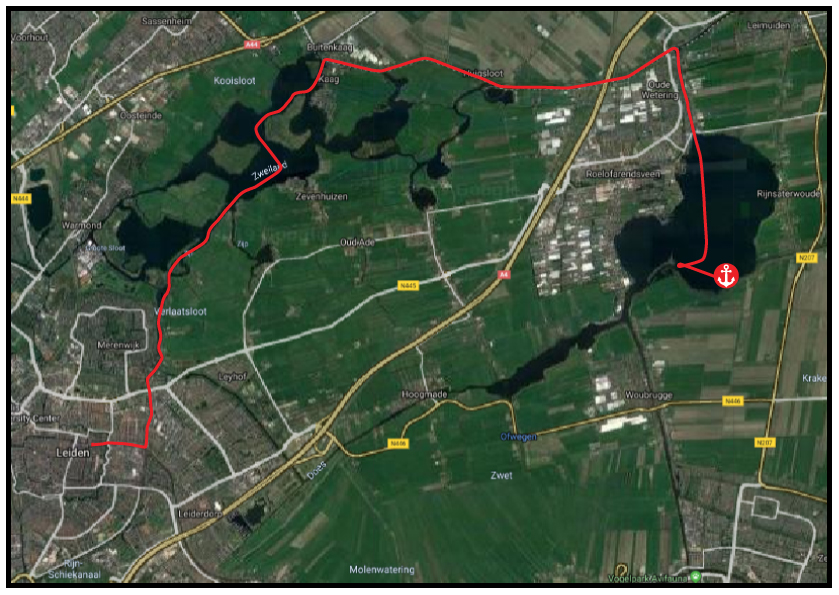
Leiden to anchorage Braassemermeer: 10,8 nautical miles

Today we really are leaving Leiden. It was raining, which was actually rather fitting because we had such a good time here. Not many bridges today, just six. And most of them we had already passed in Leiden. There used to be a time that the prospect of negotiating only one bridge would have caused a lot of stress. But now we’re already talking about ‘just six bridges’. It seems like we have learned a lot.

After Leiden we passed the Kager Plassen, a cluster of bigger and smaller lakes where Jeroen had learned to sail and windsurf many many years ago. It was quite shallow everywhere and the waterway wasn’t clearly indicated either, so we had to keep a close eye on the depth meter. At the end of the Kager Plassen you can choose to either go left to Haarlem or right to Amsterdam. And as decided yesterday, we went right.

The rain was starting to increase, but despite the rain it was actually a pleasant trip. The nice thing about smaller inland waterways and sparse traffic, is that there are hardly any waves, so we could make ourselves a steaming mug of tea along the way to keep warm.

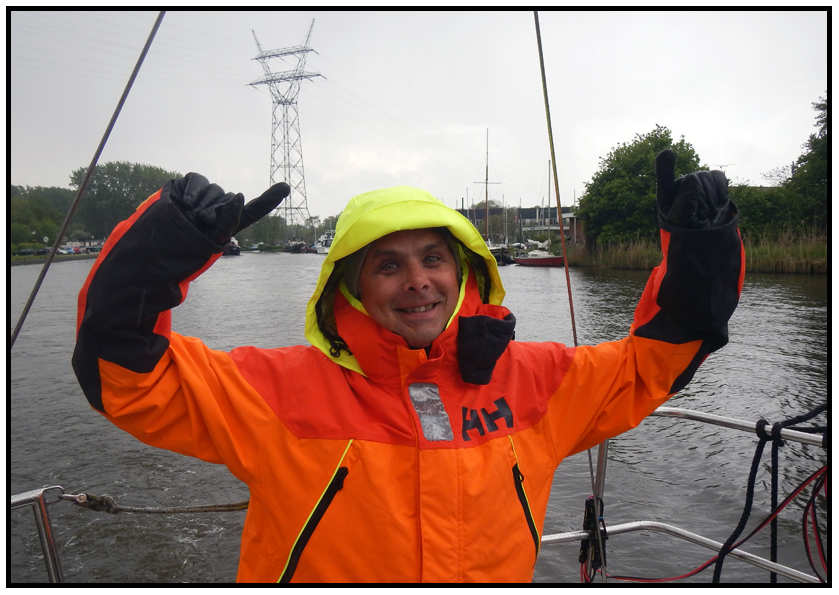
Disco in the drizzle

We were heading for the Braassemermeer where we found a sheltered mooring spot surrounded with trees and a place to barbecue. Although it was still raining now, the sun would come out at the end of the afternoon. So we pictured ourselves sitting there enjoying the warmth of the fire in the fading sunlight. We saw the entrance to the mooring, and made sure to head straight for the middle of the opening, because we had read somewhere that it was a bit shallow to the sides. The middle part was supposed to be two meters deep, and our draft is 1 meter 73, so we should be okay. Nevertheless we again kept a close eye on the depth meter. 2 meters, 1 meter 90 …careful now, 1 meter 80 … okay, were still moving, 1 meter 70 …what? 1 meter 70? 1 meter 40! We’re stuck!! We frantically thrusted backwards and left to right, trying to wriggle free from the peat on the bottom of the lake. A few stressful minutes later we were free again, and quickly backed away. Apparently mooring here is not meant to be. 

We decided to find a spot on the leeward side of the lake to anchor. Well, leeward…. there was hardly any wind at all, making it actually more difficult than the last time when we had too much wind. In the first attempt we backed away too slow, causing the chain to fall on a big heap in the peat. When we hauled the chain and anchor in, it was coated in a thick and smelly layer of goo. Yuk. A second attempt. This time we gave more thrust when moving backwards, and that worked. 

Anchor watch app on, check landmarks and hope for the best. There was no significant current and next to no wind, so would probably stay put in the same spot without anchoring.

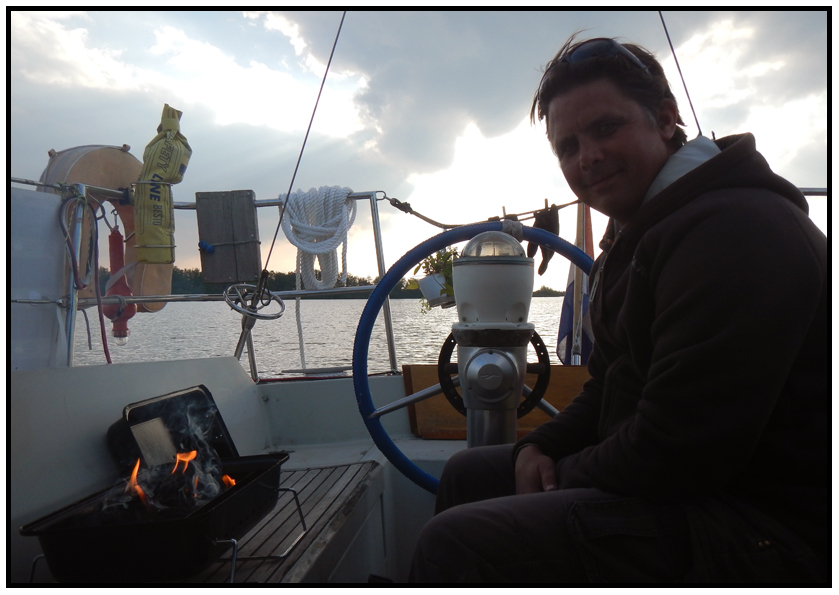
It is really beautiful and quiet here, you only hear birds singing. We spend a peaceful afternoon waiting for the rain to subside, watching the birds and enjoying the surroundings. We had planned to test the new barbecue this evening, but we were rather far from the shore. But with a few safety measures we managed to do it in the cockpit and had a wonderful dinner in the warm glow of the barbecue. And despite rain and the close encounter with the bottom of the lake, it had been a great day.

Barbecue on board