The pointless exercise of shepherding small Coots.
April 28th 2019
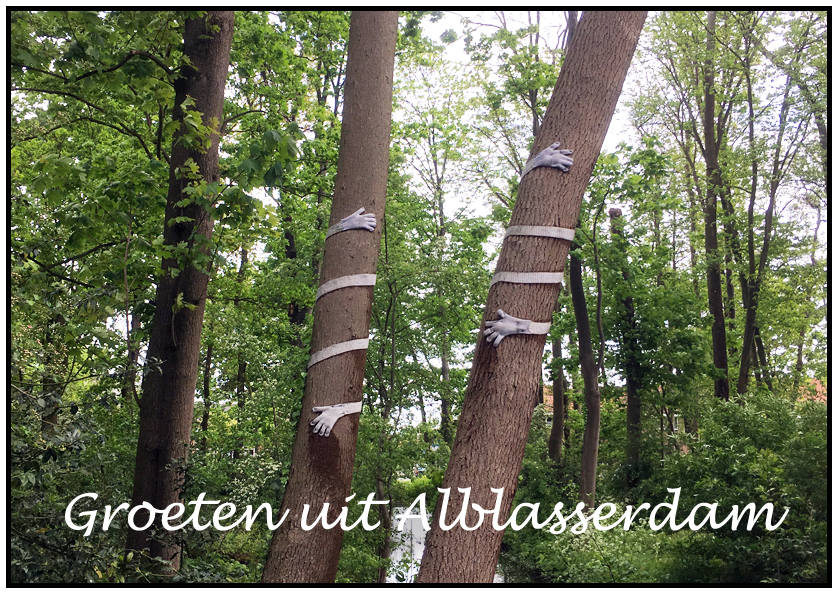
Welcome in the cuddly town of Alblasserdam!
All the chicks were alive and well the next morning, but today they were in the habit of falling or jumping in the water themselves. We scooped them out several times each, but they kept jumping or falling in so at one point we just gave up what seamed to become a pointless exercise. Maybe they’ve had a taste of adventure yesterday and are now impatient to explore the world.
Apart from the stress the Coot chicks were giving us, it was a slow day today. Lots of time for work and preparing the next stage of the trip. The weather is supposed to clear up tomorrow, so we’re leaving for Gouda.
The captains contemplating the planning for the day.
Today is Kings’ Day. Even though the marina is right in the town’s centre last night was quite peaceful. Of course there were some urban noises, though in all likelihood a lot less then there would have been in Dordrecht, because Alblasserdam is quite a lot smaller.
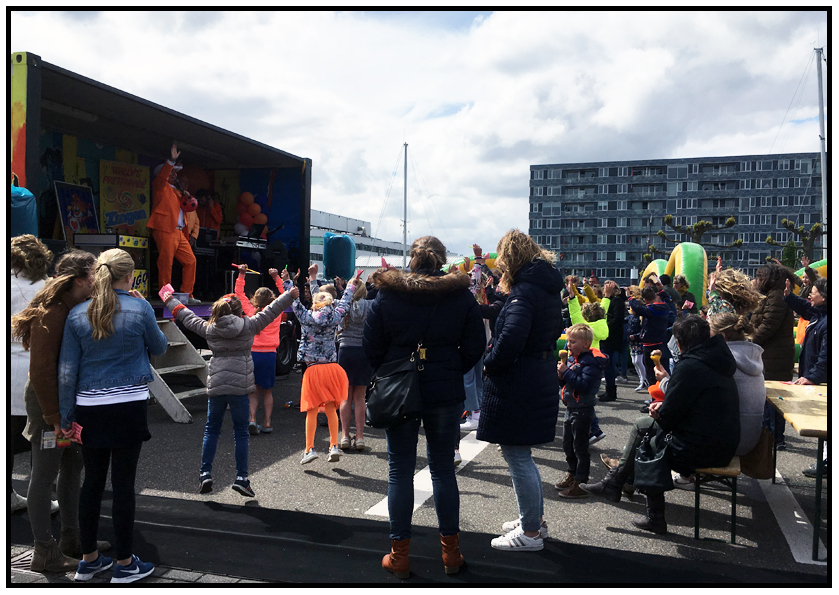
We went out to join the festivities in between rain showers. It wasn’t really bustling with activities but that was probably due to the weather. The people that had braved the weather in their orange clothes (orange is the national color) tried to make the most of it.
Orange people
A cover band was bravely singing ‘I will survive’, kids were being entertained by a guy in an orange suit and here and there were people selling bric-a-brac, old books and redundant paraphernalia. Rummage sales and flea markets are traditional on Kings’ Day, some people save up old stuff the whole year for this occasion. We didn’t stay for long. It was rather cold and the rain came again so we went back to the boat.
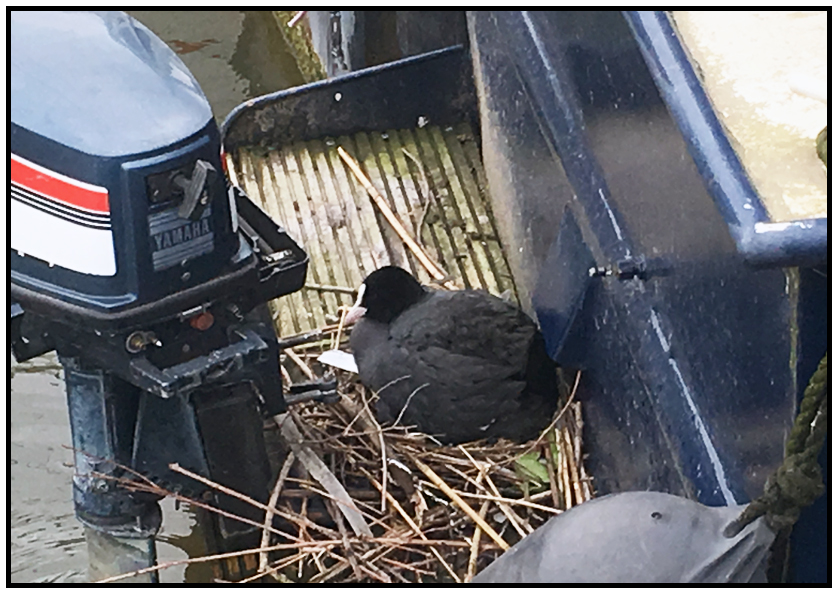
We were just savoring the aftertaste of a delicious tomato soup Jeroen made, when a small tragedy was unfolding outside. The owner of our neighboring motorboat hadn’t been here for a while and a Coot had made a nest on his swim platform on the back. But today he was back, and with gusto started his engine. We knew that the nest was there so we ran outside, and shouted that he had to kill the engine. The exhaust for the engine was 50 centimeters away from the nest and placed above the swim platform, so the hot water was gushing unto the plank where the nest sat. The Coot and her three little chicks were panicking, one chick stumbled out the nest and under the exhaust, another one fell into the water.
The coot still unaware of what is about to happen
The owner who hadn’t seen the nest had by now shut down the engine and looked out from the back to see what all the fuss was about. One chick scrambled back to the nest once the engine was silent, but the one that was drenched in exhaust water was apparently in bad shape, for he was dragging himself forward to the nest, one leg dangling helplessly behind him. The Coot was trying to drag him carefully towards her, rubbing her beak affectionately agains his. The third one was still bobbing up and down in the water, because the swimming platform has too high for him to get on.
By now the harbor master who was alarmed by the commotion, was shouting from the opposite side of the water to the guys on the motorboat that they can’t leave now because of the nest and that he would see to it that they wouldn’t because he was a fierce animal lover. The owner said sulkingly that of course he wasn’t planning to leave now he knew that there was a nest, he just hadn’t seen it.
In the Netherlands breeding water birds are protected, you can’t disturb a breeding bird or remove the nest. Every year you can see the same story unfold. Most boat owners don’t come in wintertime, so obviously the birds think that the boat isn’t going anywhere and makes a perfect spot to build a nest. When the boat owner returns in spring, he discovers there is a nest on his boat. Some owners try to block their swim platforms with nets to prevent birds from nesting there. It doesn’t always work though.
In the meantime the little chick was still in the water. We grabbed a fishing net and tried to scoop the chick out but he was slightly too far away. We passed the net to the guys on the motorboat and they managed to scoop the little chick out and put it gently on the swim platform. It quickly scuttled back to the big Coot who gave an appreciative hoot, and peace returned to the marina.
Hopefully the little chick with the lame leg is going to be alright.
Grumpy area coordinators on our way to Alblasserdam
April 26th 2019
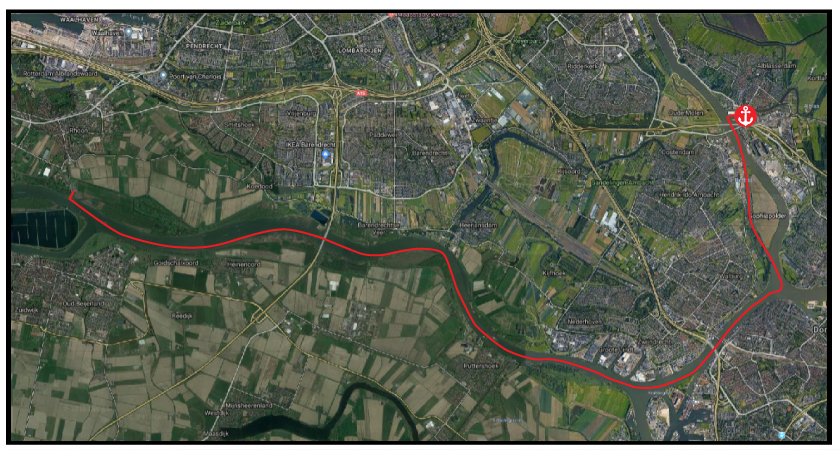
Rhoon to Alblasserdam: 14,7 nautical miles
The sun was out again, time to leave.
But first we had to figure out what the deal was again with currents and tides and such, because the next part of our journey takes us over the ‘Oude Maas’, a tidal river busy with shipping traffic. We have a tidal map, with little arrows that indicate the direction of the current in a specific tidal phase (f.i. 4 hours after high tide) in relation to a place on the map like Den Helder for instance. Okay, we still get that, sort of. But here comes the difficult part. How to determine the direction of the current at high tide at other places that aren’t mapped? No one from the hive mind was able to explain it in simple terms, so we just tried our luck and left at 11 in the morning.
Fortune was smiling at us because the Oude Maas wasn’t too busy, and we had the tide with us. The river took us through beautiful landscapes and nature reserves. The twittering of birds was sometimes louder than the sound of our engine. And then suddenly nature gave way for heavy industry and the traffic was accumulating, a sign that we were approaching the crossing Oude Maas/ Dortse Kil, one of the busiest inland crossings in Europe.
The busy inland waterways are divided into areas controlled by an area coordinator and designated VHF channels. Normally in the Netherlands if you are a pleasure craft smaller than 20 meters, you don’t have to notify the area coordinator that you are entering their area. But since this area is so busy with big container ships and sea going traffic, the coordinators tend to get really pissed off if you start crossing channels without letting them know. And since we already heard the area coordinator and some of the large vessels complain about ‘those small yachts that just do whatever’ we compliantly announced our intentions to go left in the direction of Dordrecht. He didn’t sound too happy with our notification. Maybe he was already getting worked up about ‘yet another unpredictable small yacht that isn’t going to notify us, you’ll see’, and then we did. What to do now with all that pent up aggression? Grumpily we were warned for a huge seagoing container ship behind us, that wanted to go right to the Dortse Kil. Pleasure crafts have to keep to starboard as much as possible, and the container ship was way faster than us so we had to hold in and let him go first. After that the grumpy sector coordinator told us we had permission to cross, but quickly (grumble grumble…).
Right after the crossing we had to pass two bridges at Dordrecht. They are railroad bridges with exact opening times and have a narrow time window before they close again due to the international trains that run over them. We were lucky again and arrived just under 10 minutes before it opened, which was very convenient because with all the traffic on the water in felt like being in a washing machine.
Once we crossed the bridge we passed the old town of Dordrecht. Initially we had planned to spend the night here, but we decided to sail on. Partly because it was still quite early so we could cover more miles, but mainly because tomorrow is Kings’ day, a national holiday to celebrate the Kings’ birthday. Dordrecht is quite a big city for Dutch standards and the marina we were initially heading for is right in the center of the city amidst all the bars and cafes, so it could become rather noisy and unpleasant.
So we sailed on and approached another bridge we had to cross at Alblasserdam. We tried to hail the bridge and ask for an opening via VHF, but no response. There was nothing to be found on the internet about opening times or a phone number, so we had no idea how long we had to wait. After 10 minutes of continuous attempts to hail them they finally responded. Most of these bridges are remotely controlled, so they were probably not on watch yet. We had to wait for another 20 minutes before we could pass, and without a mooring spot to wait we had to motor in circles to pass the time.
Directly after bridge lies the entrance to the marina of Alblasserdam. Since it was now half past three in the afternoon, we decided to stop here and wait for the bad weather front with heavy rainfall to pass. It was forecasted to start at the end of the afternoon and pass over in two days. While we waited for the bridge to open we tried to call the marina, but maybe it’s a thing in this town, because they didn’t respond as well. We tried our luck again and went in anyway.
We needed to pass another bridge to get to the town centre where the marina of W.S.V d’Alblasserwaerdt lies. In order to pass we needed to hail the bridge master who came racing to the bridge on her bike to open it just for us. It was a very small club run marina with only one or two empty slips, but two berth holders kindly helped us to navigate towards one of them and to dock the boat.
The harbour master arrived later and gave us the key to the gate and the sanitary building. We’ve noticed that a lot of small marinas which are run by clubs and volunteers don’t have a dedicated harbour master, just someone who does it next to his or her normal daytime job. That explains the tardiness in response.
W.S.V. d’Alblasserwaerdt
We ventured into town to get some groceries and relaxed a bit afterwards with nibblies in the cockpit before the rain came.
Although the day started with a ray of sunshine it was going to rain again. In the afternoon we thought that the rain had subdued, but alas. We were just about to start a hiking trail and fly a bit with the drone, when ominous clouds gathered in the skies again soon to be followed by heavy raindrops.
Oh well. Enough to do inside. Tomorrow we’re leaving again either to Dordrecht, or if we feel like it slightly further to Alblasserdam.
Although the forecasts for today included heavy rainfall, the day started sunny and warm. We took advantage of the good weather and went for a walk to the town’s centre. Rhoon looks like a little agricultural town, not at all like a part of the big conglomerate Rotterdam, just a few stops away by metro.
We saw a measuring point (Trig point for Federal Triangulation) on the way to Rhoon. The land register puts these measuring points in the ground for the land surveyor. They use these metal marks as reference points with which they can map areas like where the roads, plots and building sites are, or measure any deformations in buildings or objects. We gave a lecture once on geo data (geometrical data about where things are positioned) and a guy from the land register who was in the audience said that they indeed put those measuring point in the ground, but that they have lost more than half of them. They simply don’t know where they are anymore. To find out where they are they had issued a game. If you find one, you can upload the coordinates to a special geocaching website:(https://www.geocaching.nl/overzichtskaart-rd-meetpunten/). But this one is so rusty, you can’t decipher the number anymore.
A rusty Trig point
By the way, the have lost a few hundred border marks as well. Anyone up for a new game, Germany and Belgium perhaps?
We did some groceries, and discovered a lovely little chocolaterie halfway back to the boat. The fragrance of melting chocolate was wafting into the streets. We couldn’t resist the temptation and we stopped there for a coffee and pastry.
There is a washing machine at the marina of Rhoon, and it was high time to do the laundry. Every marina has a different washing machine and a different system, so you always have to figure out how things work first. And doing the laundry in a marina is also different than at home. You set a timer, so that you can be back at the machine when the program ends. It has happened that if you are too late some else comes along and takes your clothes out. That wouldn’t be a problem if they put it neatly in a basket, but it happens that they just dump it on the floor. Sometimes other people even stop the program halfway and chuck your clothes out, because they are in a hurry and think they consequently have the right to go first. And it has even happened that items disappear. Maybe someone was in dire need of socks? That’s why doing the laundry as a liveaboard is planned with military precision.
Another liveaboard in the marina kindly explained the system and warned us for the presence of ruthless people that stop the program halfway. Apparently it also happens in Rhoon.
But there were no culprits lurking about, eager to disrupt the washing cycle this time allowing us to continue without further ado to the drying stage. Some of the clothes like T-shirts we don’t put in the dryer because you don’t want to end up with Barbie sized shirts. And the convenient thing of a boat is that you always have enough washing lines in the form of life lines to hang stuff on. It was however forecasted to rain, so we kept an eye on the increasingly darkening sky. Of course, in the end we still had to rush to get it all inside when the rain finally came before it got wet again…
Anchorage near Hellevoetsluis to Rhoon: 16,1 nautical miles
When we woke up it was still quite windy. It was blowing a steady 18 knots, so we decided to hoist anchor and leave for Rhoon. Now I’m sure that all you experienced salty sailors would do it in a jiffy, but for us hoisting an anchor with wind force 4 to 5 is something to be a bit nervous about. Before our worries concerned an anchor that would break free. Now we were concerned that we couldn’t get it out. In theory you should slowly sail towards your anchor which makes it easier to haul it in. Slowly we eased forward and started to haul in the chain, but keeping the boat from drifting over the anchor is not that easy when the reality doesn’t look a bit like the YouTube ‘how to’ movies with calm waters and sunshine. Despite all the waves and the wind we managed to get the anchor aboard and set course for Rhoon. We had head winds and it was still blowing an average of 18 knots so no sailing today unfortunately.
The Haringvliet is quite broad, and our position now being the lee shore (the side where the wind is blowing towards for all you landlubbers:) the wind waves were creating a bumpy ride. So we were happy to leave the Haringvliet and enter the Spui, a smaller more sheltered water way that lead towards Rhoon.
We passed little towns and typical Dutch landscapes with windmills -the modern versions- and the obligatory sheep and cows.
After a relatively uneventful trip we arrived in the marina of Rhoon. The sun was peeping through the clouds again so we relaxed a bit in the cockpit and enjoyed the remainder of the sunshine.
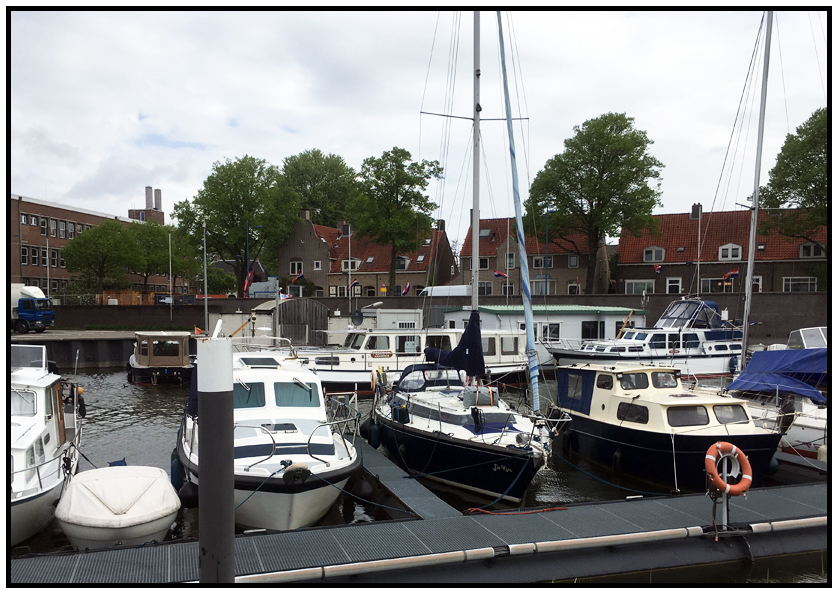
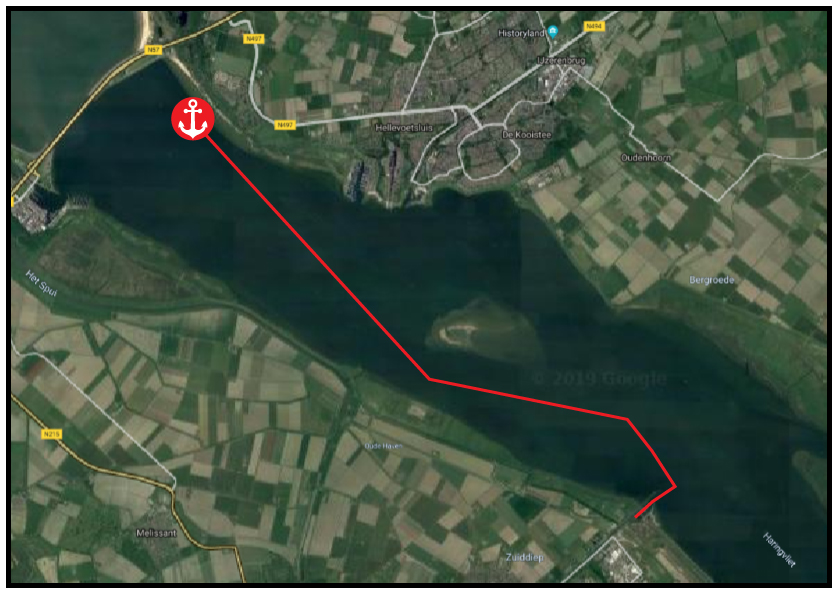
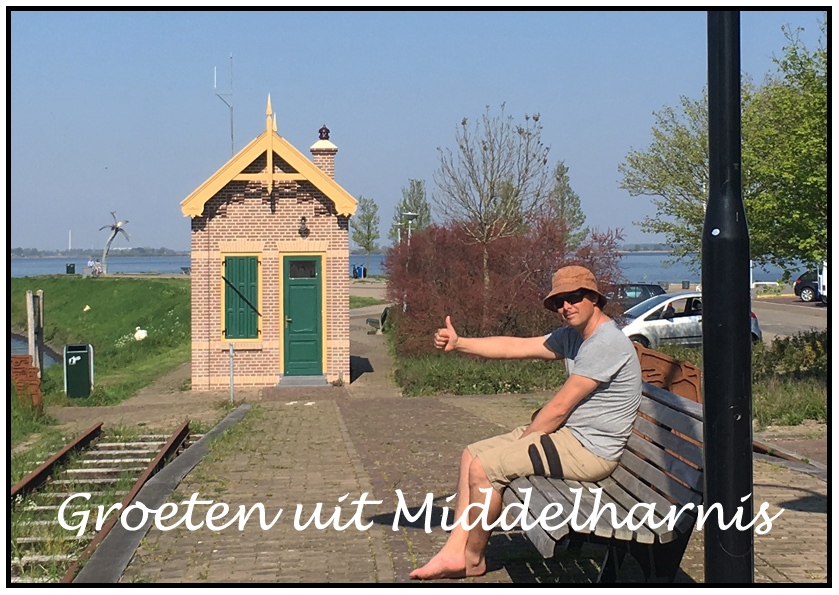
Middelharnis to anchorage near Hellevoetsluis: 6 nautical miles
Today it was time to leave again.
The newly installed lamp had started to have a mind of its own during the night, switching on and off on its own account. So Jeroen dismantled the whole thing during the night. Something to look into another time.
Around noon we untied the lines and left Middelharnis. We had favourable winds and the jib was working again so we decided to sail to Hellevoetsluis where we had planned to anchor. In the meantime we noticed that the transducer was still not working. Had we put it back the wrong way round? Another chore back on the to-do list again…
Although we felt that it was time to continue our journey, it was actually a bit hard to leave. We really felt at home there in that little marina. Even Captain Fluffy enjoyed himself there, frolicking in the high grass. We now understand what a friend of ours meant when she said that you should take your time when you travel. Not only to enjoy every moment and not to over hasten things, but also time to say goodbye. Naively we thought that we only had to say goodbye when we started our journey. We hadn’t realized that travelling is not only discovering new things, but also saying goodbye over and over again.
After a nice sail we approached the spot we had picked to anchor. It was the first time ever anchoring for us, so we experienced a fair bit of anxiety. We wanted to try the anchor in a familiar place first, so we picked a spot in an area we knew, that was relatively sheltered, and if we would be so unfortunate to break loose that we wouldn’t crash into something immediately.
Engine on, sails down, time to anchor!
After sailing towards the wind first, we backed away slowly mostly by the force of the wind, dropping the anchor at the same time. The depth was 5.7 meter , so we lowered 30 meters of chain which would presumably be enough for wind force 3 to 4. It seemed like the anchor was holding, so we shut down the engine. Fingers crossed! We wrote down the GPS coordinates and started a anchor watch app that we had recently downloaded. The app causes an alert to go off when the position of the anchor changes.
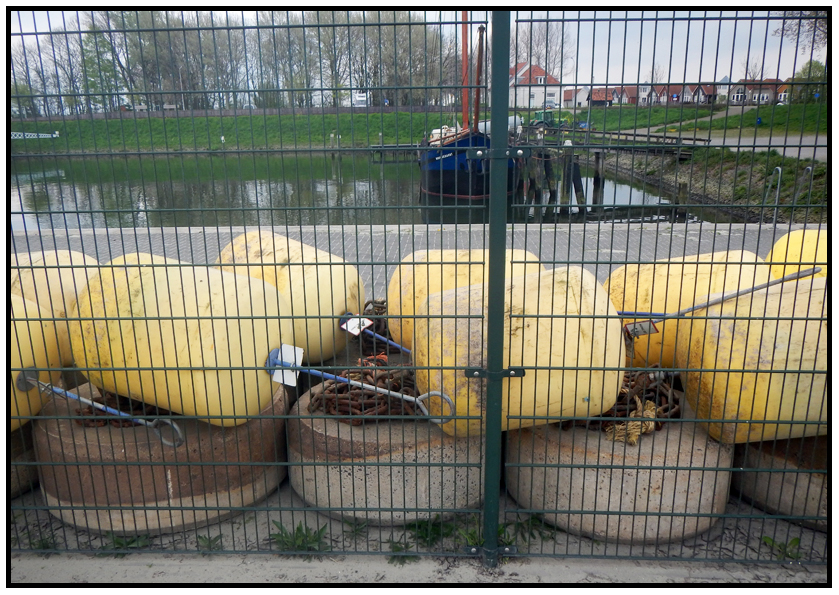
We had used mooring buoys before, but never an anchor. We always thought that they were preferable above an anchor, because they looked so sturdy and seemed safe to use. But on the internet you can find a fair bit of warnings against those mooring buoys, that in fact they aren’t safe at all, especially with high winds. And you never know for sure when they were last checked or hauled out for maintenance, so they might be in a dodgy state. Here in the Netherlands they take the mooring buoys out of the water in winter for maintenance, in that sense their durability is checked regularly. The buoys were still on the hard in the depot when we were in Middelharnis because it was still early in the season. And actually it was rather unsettling to see how small the concrete blocks were to which the buoys were attached. We now can imagine that they wouldn’t be able to hold the weight of a sailboat in a storm.
The mooring buoys with their concrete blocks on the hard
It was still quite warm and a refreshing dive would be welcome, but the water temperature was still around 13 degrees Celsius. Way too cold for a swim. But fear not! There is always a solution. We had bought a solar shower, an filled it up yesterday with the intention to try it out. But we has completely forgotten all about it, until this moment. So we got out the soap and tried the shower. It might need some tweaking, but it works reasonably well. It holds 20 liters of water, but we hadn’t even used half of it.
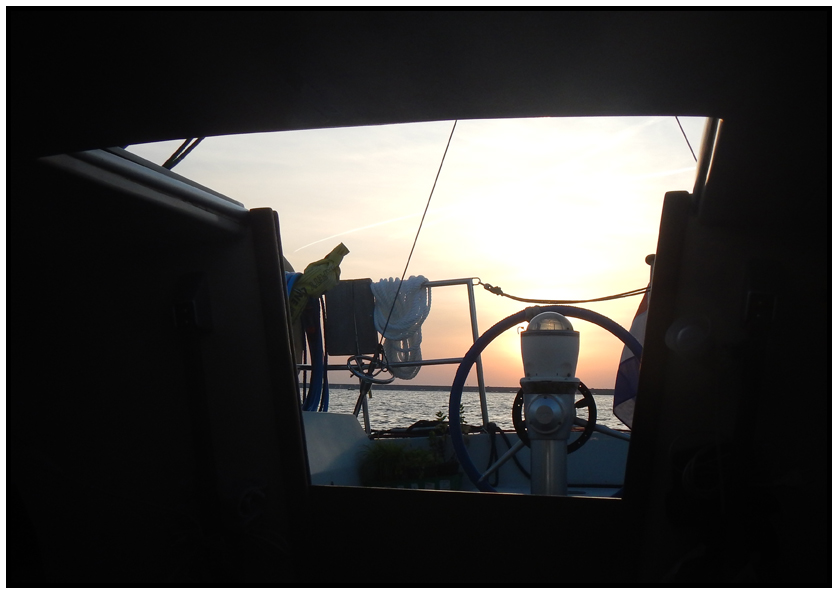
A view of our first sunset at anchor
Refreshed by the shower we had a lovely dinner with asparagus when the wind started to pick up. The forecasted 3 Beaufort turned out to have become a steady 4 with gusts up to 5. As we were still a bit nervous about our first time ever anchoring, and the app was a bit dodgy, we installed 2 more anchor watch apps to notify us if we were dragging.
The wind was increasing ever more, so when we went to bed it felt more like being in a cocktail shaker than a comfy v-berth. Captain Fluffy was also not amused and jumped up with every big jolt. And with every crash or creak there’s this little voice in your head that says “are you sure we’re still securely anchored? You can imagine that we didn’t have a good night’s sleep…
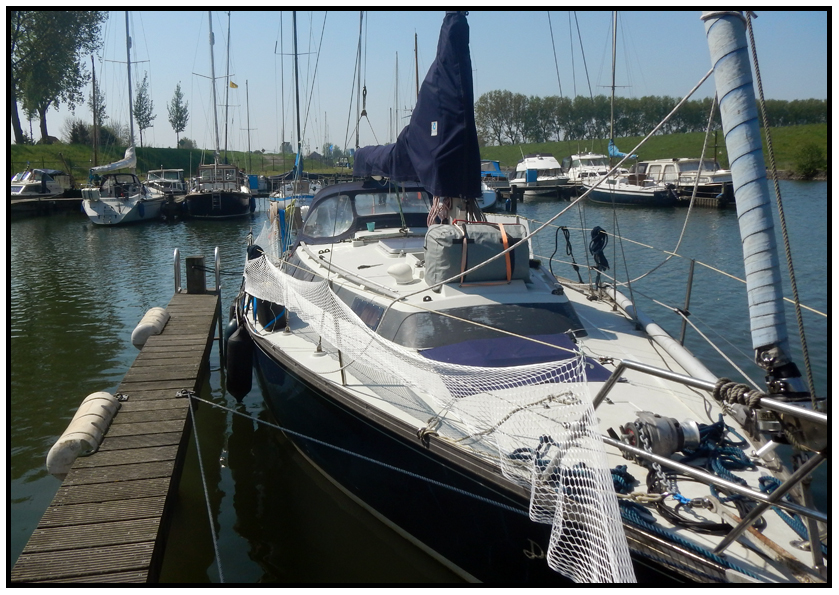
Another sunny and warm day, a perfect day to work on the safety net for Captain Fluffy. We unrolled the net we had bought and fastened it in a makeshift manner to the sea railing to see if we had enough and how we would attach it permanently.
By doing this we encountered 2 problems. The first one was that part of the net had to be removable, so that Captain Fluffy could jump on and off when we are in a marina. The second one was how to deal with the jib sheet. The line now crosses underneath the sea rail into the genoa track. But if we would fasten the net, the sheet had to run through or under the net, both not very desirable options. We couldn’t think of a sensible solution, so in the end we decided to tackle project safety net another time, and check out how other people have done it first.
On to the next task then, cleaning the water tank. Not that complicated, just put some food grade oxi (Sodium percarbonate) in your tank, fill her up and wait for 30 minutes. Then empty the tank, fill her up again and empty again. Jeroen got the idea to clean the bilge at the same time, something we still had to do if you remember that the bilge pump went completely berserk 2 weeks ago. We have a foot pump to operate the water tab, and emptying the water tank takes ages this way. But by disconnecting one of the hoses that run from the tank to the tab, the water -with the Sodium percarbonate- runs into the bilge minimizing our effort and cleaning the bilge at the same time!
Captain Fluffy is lending a helping hand in cleaning the bilge
Then there was another chore that needed to be done. A very scary one. We had noticed that the display wasn’t giving any readings of our speed. We hoped that with a few days sailing the moss or whatever was stuck to the transducer would dissolve or something, but it didn’t. The only thing left now is to pull the transducer out of its socket and clean it manually. The scary part of this story is that once you pull the transducer free from its socket, you basically create a 4 centimeter diameter hole in the bottom of your boat below the waterline. That means water will come gushing in. Now you have a sort of plug that you need to shove in the hole immediately after removing the transducer, but it is still rather scary to make a hole in your boat on purpose while it’s in the water. After cleaning the water tank and the bilge we knew for certain that the bilge pump was working, so after few deep breaths it was time to pull the plug. The water started to squirt out the small gap, when the transducer was unscrewed which was rather alarming, but when the whole thing was out of its socket it went more like …gloop…gloop…gloop. It wasn’t gushing in like we were expecting. Of course you shouldn’t put on a kettle to make tea after you have unscrewed the transducer, but there’s enough time to push in the plug and screw it down. As it turned out a family of tiny shrimps and some small mussels had made the wheel of the transducer their home. Sorry guys, but it’s time to relocate. We gently pried them loose and released them in the water again. A quick scrub, and the transducer was ready to be plugged back. It all turned out to be not that scary as we were expecting.
Mussels for dinner
We also installed a new lamp at the chart table, so the to-do list is definitely shortening. That is, if you’re ever done with chores on your boat.
We concluded our last day here sampling some home-made beer and cider with our harbour masters Arthur and Saskia on their boat and shared more adventures. They told us about how they ended up as captain and host on a 80 foot classic charter yacht, the Vixen II, in the Mediterranean and how they participated in regattas like the Ibiza Gold Classic with this majestic ship (see movie). It was great to have met this inspiring couple.
Tomorrow we’re leaving to test out our anchor for the first time!
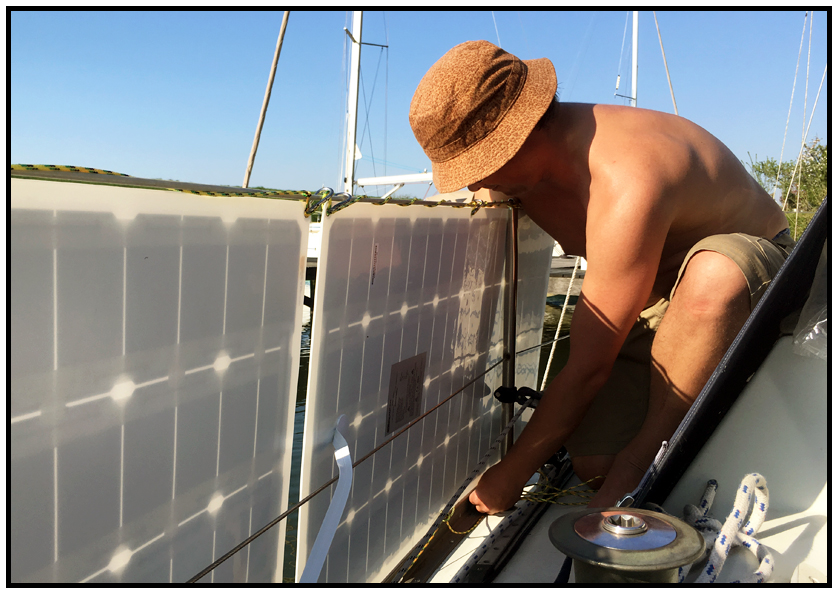
Yesterday we installed the solar panels. And since it was going to be a warm and sunny again, it was a good day to test the yield. And it looks promising! Today is a really sunny day of course, but it looks like we generate more watts than we use. So that is perfect!
It looked like the whole country was getting into their boats to spend the day on the water, so we were actually quite happy with this a quiet and secluded spot here in the marina. And tomorrow and Monday most people will have a free day, so it will be even busier. We might indeed put off the next trip till after the Easter Holidays.
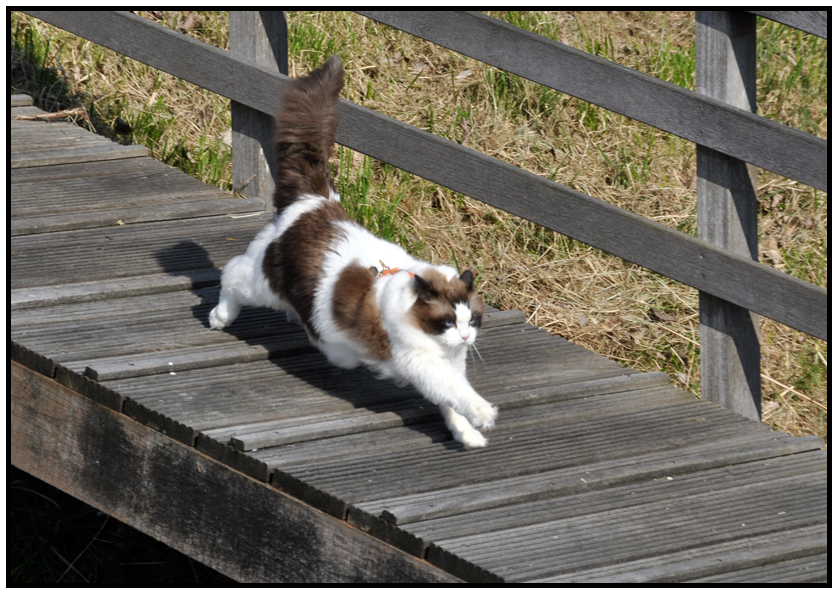
Captain Fluffy on the run
Time to enjoy the glorious weather. Captain Fluffy’s opinion of enjoying the sunshine was running around in the grass, and make us chase him. We disagreed, so after the impromptu exercise we thought we deserved a refreshment so we took a short walk to the beach without Captain Fluffy and ate ice cream in the sunshine.
It was promising to become a really warm day. Funny that just four days ago we sailed with thermo underwear to this marina, and now we’re walking around in swim wear.
The beautiful summer weather was ideal to finish the solar panel project. The new connector had arrived, so we could finally connect the last cables and install the panels and monitor permanently.
It was way too hot to do more chores, so while Captain Fluffy was making new friends with Pepper, the harbour master’s dog, we enjoyed home made beer in the sunshine.