A bumpy ride

Shapeless sails and steep waves

May 27th 2019

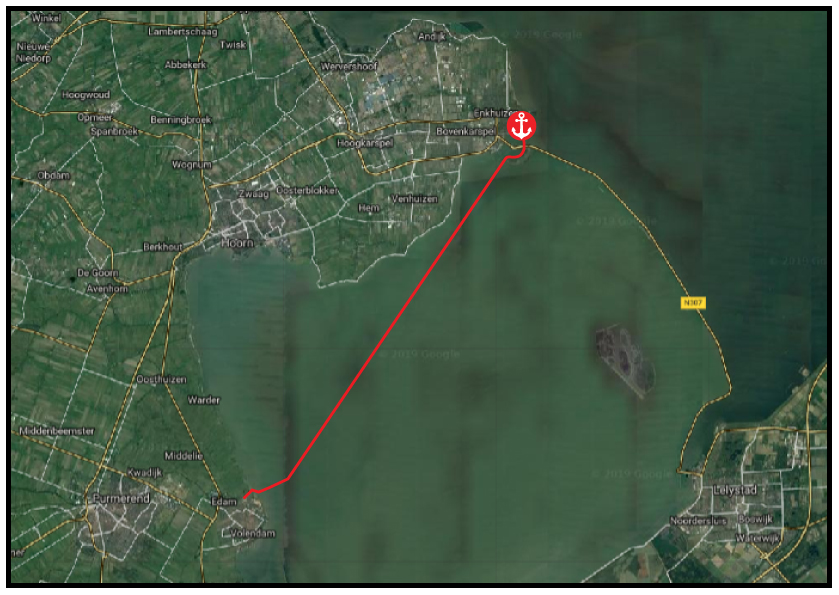
Edam to Enkhuizen: 15,2 nautical miles

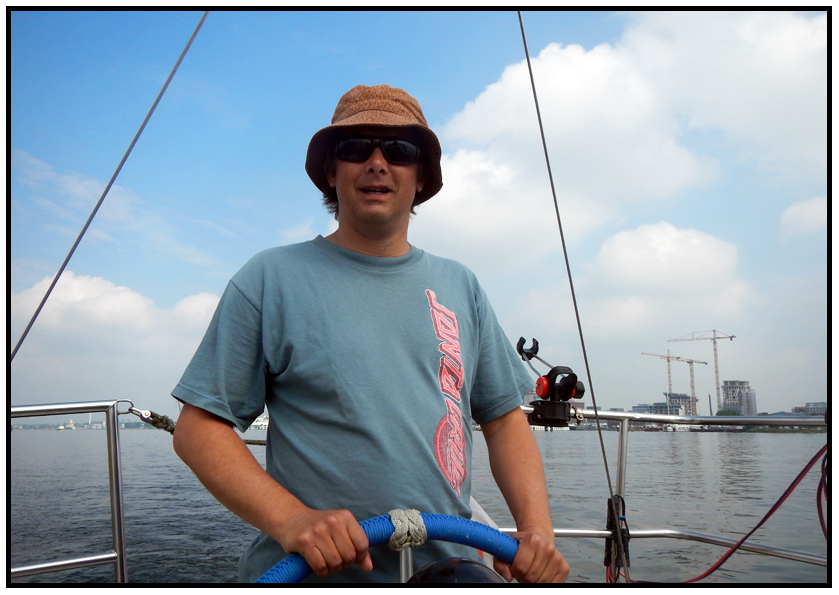
The weather forecast predicted 3 to 4 Beaufort for today and blowing straight towards Enkhuizen, so we decided to leave. We left the marina and hoisted our genoa first to see what the wind would do. It started out fine, we had a steady breeze and made good speed. But then the wind started to increase rapidly and soon it was blowing a steady 4 to 5 Beaufort. Our genoa is really big, and since it is probably one of the original sails it would be 40 years old, just as old as our boat is. After all these years it has completely lost its shape. It would only blow up like a balloon, trapping the air flow and tilting the boat over forwards which was not really pleasant. And since we’re not very experienced yet, we don’t know how to handle the ever increasing wind with the shapeless sail. We tried furling in the genoa a bit to minimize the amount sail, but that didn’t really change much. After the wind had increased even more with gusts up to 36 knots we had enough and decided to furl in the genoa and continue by engine. So much for 3 to 4 Beaufort.
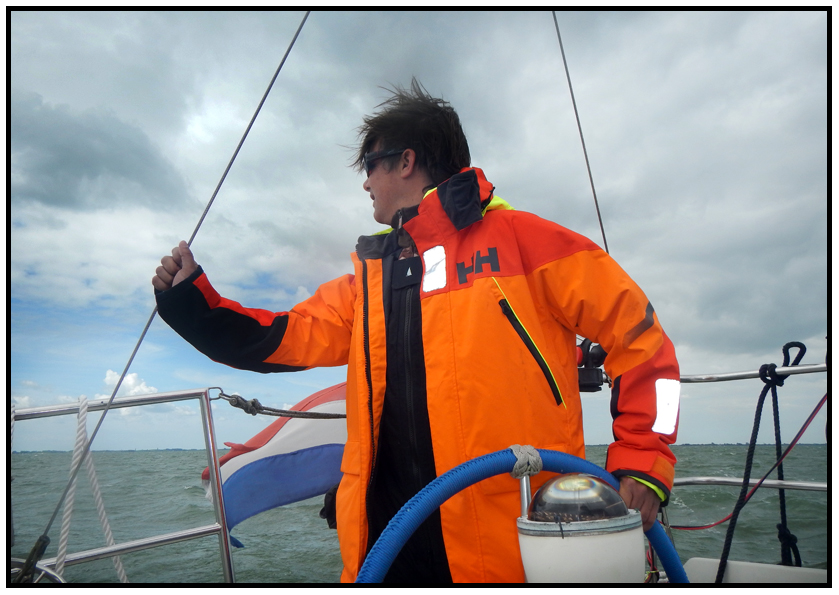
Jeroen looking anxiously at the waves behind us

We were in for a bumpy ride. We were already halfway the Markermeer and the waves had time to build up on the open water, resulting in short but relatively big waves. The waves were sometimes even crashing into the cockpit from behind.

After being tossed hither and thither for almost 4 hours we finally reached the lock where we could exit the Markermeer and enter the IJsselmeer, also marking our destination. The marina of Enkhuizen lies right behind the lock.

No shortage on marinas here in Enkhuizen. There is a big municipality marina spread over three locations in the inner city. There is a also club marina near the train station and a huge commercial marina. Enkhuizen must be a popular spot since all the marinas were already quite full, and it isn’t even mid season yet. We chose to moor in the Oosterhaven, one of the three the municipality marinas.

After we had left the locks we hailed the harbour master who directed us to slip nr.66 in the Oosterhaven. Upon arrival it looked quite narrow, but since the harbour master had directed us to that slip knowing our width, we must assume that it will fit. But it didn’t. We entered slip but got stuck one third in. It was way too narrow. With some effort we prised ourselves loose, moored temporarily on the opposite side of the canal and hailed him again over VHF to say it didn’t fit. “Impossible!” he said “The slip should be almost 4 meters wide!”. We assured him that it really wasn’t, since we were 3,20 meters wide. He couldn’t appoint another slip immediately, since he was on his bike opening bridges and all, and had forgotten to bring the list. So if we could stay afloat for a while he would race to the harbour office and check for available spaces and hail us again. In the meantime we had seen that slip 55 was empty, looked broad enough and had a finger dock thus we suggested to dock there. The harbour master agreed, so we started the engine again and docked in slip 55. Or so we thought. When we were fastening the mooring lines we saw that it wasn’t 55 but 51. Wrong slip! We didn’t feel like relocating after the rough trip, so we hailed the harbour master again and told them that we had docked in the wrong slip. “My bad” I said, “ I wasn’t wearing my glasses”. Fortunately it wasn’t a problem to stay here. We were relieved to be done with it all.

We went to the harbour office to pay. In Enkhuizen paying for a slip is fully automated. Another first today, paying at a ticket machine. The machine printed a sticker we had to attach to the boat. We also had to buy a card from the machine to pay for electricity, water and showers.

After the usual post-mooring stuff like connecting shore power, cleaning up sail gear and reverse the saloon into living mode again we settled down in the cockpit to recover from the bumpy ride. The weather was cooperative for once. The wind had died down and there was even a ray of sunshine peeping through the clouds. Captain Fluffy didn’t need to recover from the passage. Although he had spent the whole trip in the V-berth, he almost immediately jumped on the finger dock and went off exploring. It looks like he already feels at home here.

There goes Captain Fluffy…

Enough clay for a pottery

Sailing to Edam from our anchorage

May 20th 2019

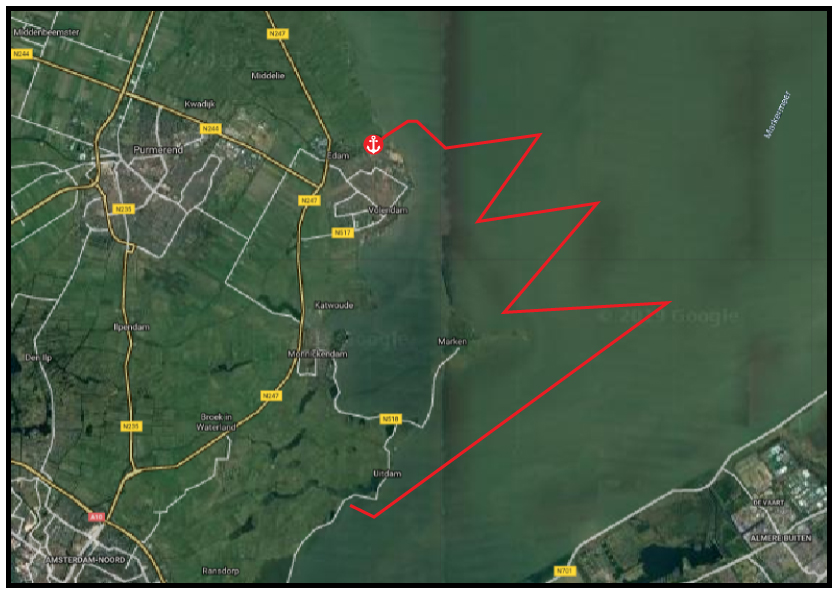
Anchorage near Uitdam to Edam: 15 nautical miles

The weather is changing and the barometer is plummeting like a rock. Time to move today because tomorrow the wind is going to increase even more and it will start to rain. Despite our worries of the last days our anchor had set well. We could tell it had dug in really deep, because when the last shackles and the anchor surfaced it was covered in such a thick layer of clay that we could provide for a whole pottery.

We had also dragged up pieces of pond weed (Potamogeton), common water plants for this area that in summer grow so fast that the authorities need to mow them to enable boats to move. But it is still springtime so hopefully the growth isn’t that severe yet. As the plants appear to be edible we probably need to graze our way through the Markermeer in summertime.

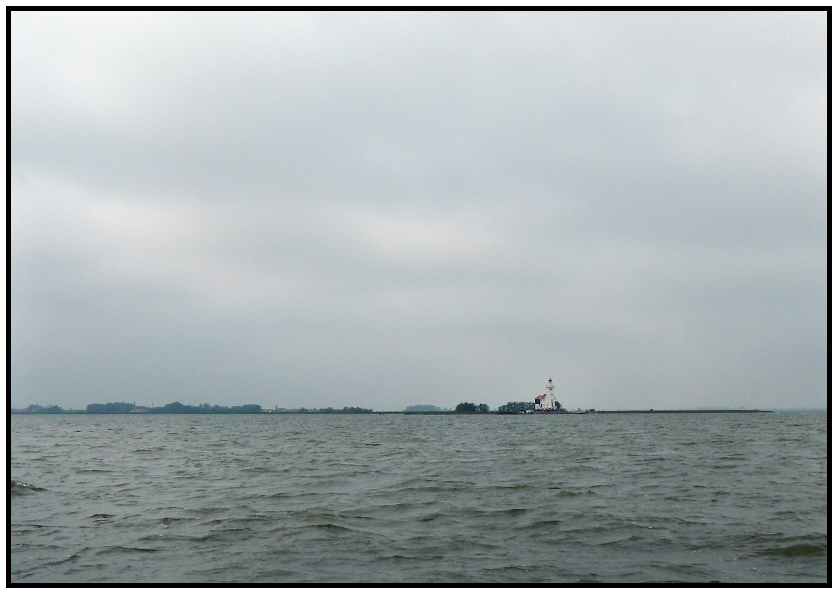
The Horse of Marken in the distance

The wind was perfect for sailing, thus after hauling in the anchor we hoisted all the sails and headed towards Edam. We made good speed, and soon rounded the Horse of Marken, a historic lighthouse built in 1839 on the former island. Although heavily overcast, it was quite an enjoyable sail. Later in the afternoon the wind started to increase steadily, and before long it had increased to wind force 4 with gusts of 5 and was still increasing. All the other sailboats were heading towards shore, and soon we were the only boat left on the water. But we were already approaching the entrance to the marina of Edam, so we took down the sails and traversed the last bit by engine.

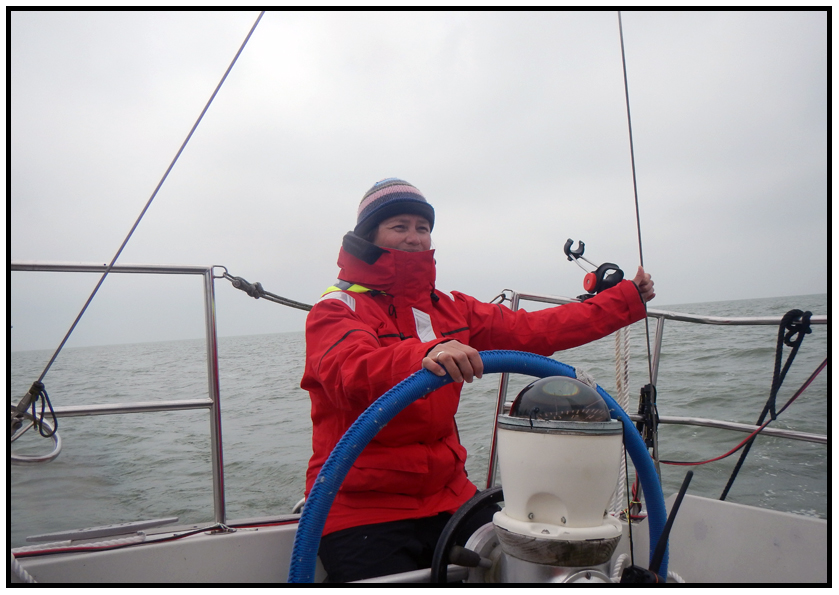
Carmen at the helm

The harbour entrance was a bit shallow for our draft, but we docked in the marina of W.S.V. De Zeevang without difficulties. What proved to be difficult was getting electricity. Just like in Leiden, there are poles with sockets in which you have to insert €0,50 to get electricity. But after trying two sockets and loosing 2 coins we decided that this is a problem for tomorrow.

A matter of faith

Building a relationship of trust with your anchor

June 19th 2019

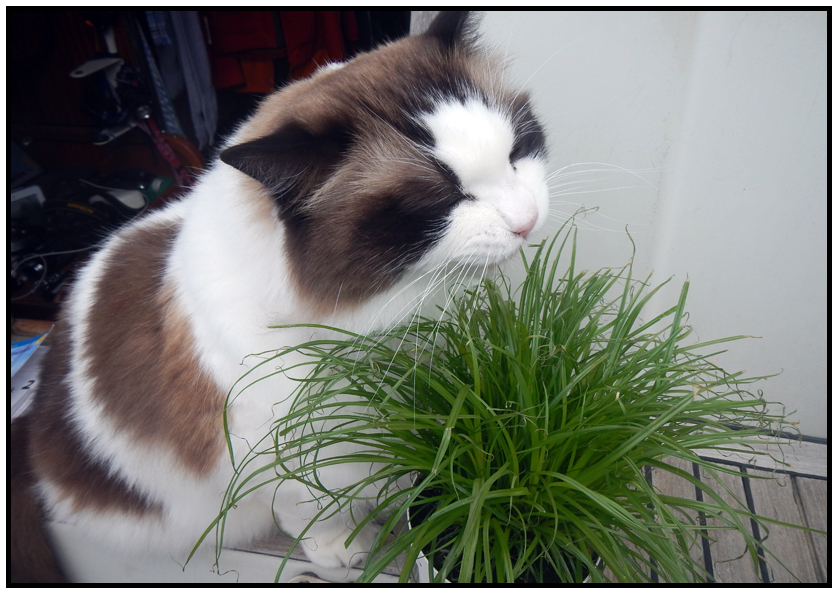
Captain Fluffy is enjoying his mini garden

At 3 in the morning the anchor alarm went off again. But after checking the anchor itself and the coordinates of our position, it looked like we were still more or less in the same spot. Confusticate and bebother this dratted alarm! Whatever could be the reason for it to go off without reason? We were confident that it had to be false alarm, but it is not really pleasant to wake up to the sound of a diabolical alarm going off.

We tried to analyze what could have caused the alarm to go off. In the morning light we checked our position in relation to the shore. Judging by the visual reference points we hadn’t moved. If we had been dragging, it couldn’t have been much. So if we hadn’t been dragging what then? Our deduction was that it could have something to do with the timing of activating the anchor watch app. How the app works is that it uses GPS coordinates to mark the spot where you drop the anchor and then draw a circle -for example 25 meters in diameter- around that spot. Then you move back and let out anchor chain, depending on the depth, the current and the wind. You can see the position of the boat as a dot in the circle. So you can pivot around your anchor in all directions, as long as you stay within the circle all is well. If you start to drag and the dot representing the boat moves out of the circle, the alarm goes off. This works perfectly well if you activate the app at the exact moment you drop the anchor. But if you drop the anchor, move backwards to let out 20 meters of chain and then set the alarm, it draws a circle around the GPS coordinates of your boat, and not the anchor. With 20 meters of chain and a circle of 25 meters diameter the anchor would actually lie somewhere near to the edge of the circle. In this case the wind had shifted 45 degrees, causing the boat to pivot around the anchor and thus moving it out of the circle. We figured that this might have caused the alarm to go off, because when checking our gps coordinates and the visual reference points we were still at the same spot. Next time we should set the alarm at the moment we drop the anchor, or note the GPS coordinates, and not 5 minutes later.

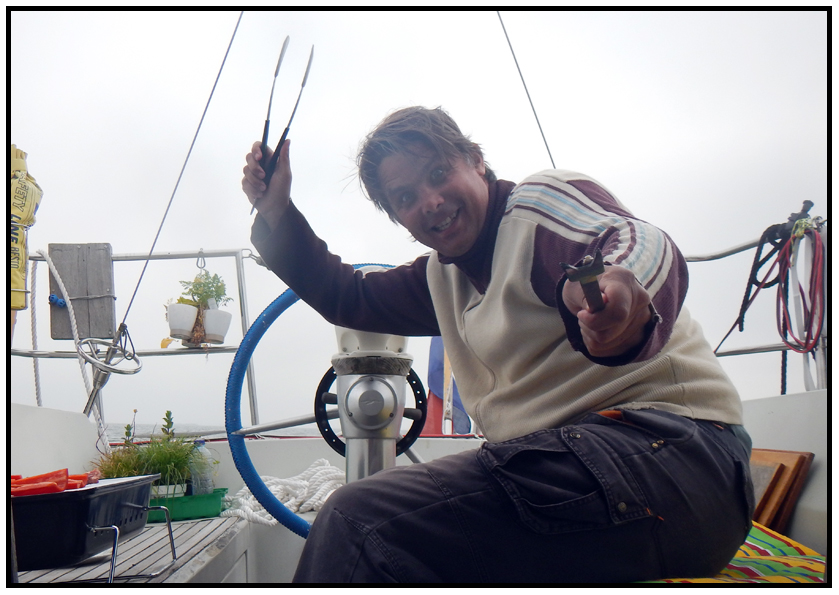
You often read that you must develop a relationship of trust with your anchor. So we tried to relax and put faith in our anchor. It helped that the sun was shining because everything looks a lot better in the sun. We ended the day with the conclusion that we had set the anchor properly and made the right decision to stay. Enough reason to celebrate with a barbecue in the cockpit.

Foolish gamble?

Dodging ferries and anchor alarms

June 18th 2019

Amsterdam to anchorage near Uitdam: 9,2 nautical miles

Time to leave the capital and continue north. First we had the follow the IJ-canal (IJ is an old Dutch word for water) past Amsterdam Central train station.That meant zigzagging through canal boats, dodging ferries and big barges and keeping a lookout for small motorboats with crying children, fussing grannies and lounging parents at the same time. The ferries are not too bad, but the canal boats are under the impression that because they’re professional traffic, they have the right to ignore basic rules and behave like jerks.

Looks almost like a painting from the Romantic period

After a chaotic trip down the IJ-canal we finally reached the Oranje locks. It had just closed so we moored to the waiting dock and awaited our turn. Since they have 3 locks here for pleasure crafts it wasn’t long before we could enter another. Right after we had cleared the lock we were faced with the Schellingwouder bridge, which was closed and wouldn’t open for another 25 minutes. Strangely in contrast to the Oranje locks that run every 10 minutes, there were no waiting docks here. The stretch of water in between the locks and the bridge is like a small turbulent basin of water caused by the large barges and speed boats that can pass under the bridge without an opening. Nothing to it than treading water and dodging barges and wait for the bridge to open.

Zigzagging through the IJ canal

After 20 minutes we finally entered the Markermeer, a closed-of part of the IJsselmeer. The plan was to find a nice quiet spot to anchor after 10 days in Amsterdam. Friends had given us tips where to anchor, but unfortunately our draft was way too deep for those locations. Slowly we progressed north, heading towards a spot we had seen on the map that might offer some shelter from the wind and waves.

When we finally arrived at the spot it looked promising. Not as idyllic as we had imagined, but quiet and away from the crowds. We dropped the anchor, activated the anchor alarm app and checked the visual reference points for 5 minutes. No movement, hopefully the anchor has successfully set. The sun was shining abundantly so we spend a lovely afternoon in the cockpit enjoying the peace and quiet.

In the evening the wind picked up and started to change direction. But since we knew that was going to happen we had taken the rotation into account when dropping the anchor. Everything still looked okay, so we were reasonably confident that we had done a good job. But right before we wanted to go to sleep, the anchor alarm went off. You can imagine that shook our confidence. What had happened? Didn’t we read the position correctly before? Could the anchor be dragging due to the change in wind direction? We were wondering if hoisting the anchor and reset it was the right thing to do. And if we wanted to reset the anchor, this might be the right time since it wasn’t dark yet and we could still see what we’re doing. But on the other hand we were quite confident that the anchor had set properly. While we were discussing what to do it slowly had become dark, and the anchor alarm had gone off yet again. The unnerving alarm was not really boosting the already brittle confidence we had in our anchoring skills. In the end we agreed that we would not re-set our anchor and stay in this spot to see if we’ve done it correctly. We’d rather not sleep and reset the anchor in the night than move now and forever doubt if we had done it correctly. And we had reasonably light winds and nothing in the vicinity that we could hit, so we could intervene quickly when dragging. So we took the decision to trust our gut feeling and ignore the alarm. Time will tell if we have taken a foolish gamble.