May 8th 2019
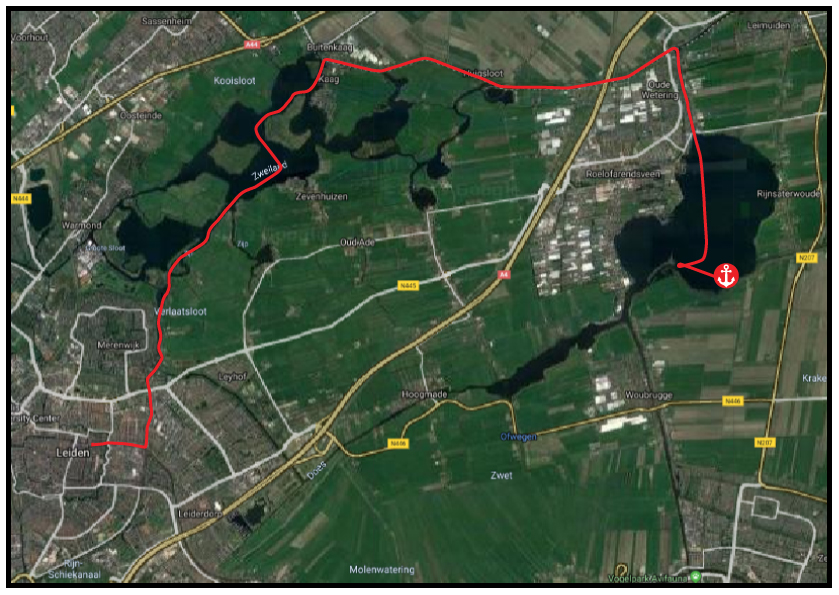
We were rudely awakened this morning by a clashing sound, followed by the anchor alarm going off. Apparently we were dragging, so we jumped out of bed to check on the anchor. We had indeed been dragging, but fortunately not much. But the wind direction had shifted and a quick check on the weather forecast told us that the wind would turn 180 degrees and increase to wind force 5 when a thunderstorm would pass over. Yesterday when we checked the weather forecast the wind would continue to blow from the east, and although rain was predicted, nothing was said about thunder and lightning. Well, you know what they say, nothing as unpredictable as the weather. No wonder our anchor was dragging. It probably didn’t have any grip in the slushy peat bottom.
What shall we do now? Reset the anchor or continue to Amsterdam? The next stage would lead us to the Nieuwe Meer lock, the start of the nightly passage. But then we would have to leave within 15 minutes otherwise we would miss the bridge opening over the A9 motorway near Schiphol at 12.30 hours. We had planned to stay here for 2 or 3 days so we weren’t expecting to be faced with this decision right now. Choices, choices. And we had to decide quickly, because we were still dragging. And all that on an empty stomach and without a drop of coffee.
We made the decision to hoist the anchor and continue to Amsterdam. We quickly put on our sail gear -in the meantime it had already started to rain- pulled the anchor out of the sludge and continued to Amsterdam.
We past another big stretch of water, the Westeinderplassen. Initially we wanted to anchor there as well, but the whole lake is even more shallow than the Braassemermeer. And we didn’t feel like repeating yesterday’s close encounter with the ground again. But definitely a beautiful place to go to if you have a boat with less draft. This lake and the Braassemermeer, where we were yesterday, all used to be peat bogs. After they had dug out the peat these lakes with their tiny islands and small drainage canals were left. You can moor between the high reeds or at the tiny islands. But alas, not for us. Onward we went through the drizzling rain.
Suddenly the depth meter jumped from 2,5 to 1,4 meter! A submerged bump in the waterway! The boat lurched back and then catapulted forward like we were being launched over a ramp. These are truly the days of insufficient depths…
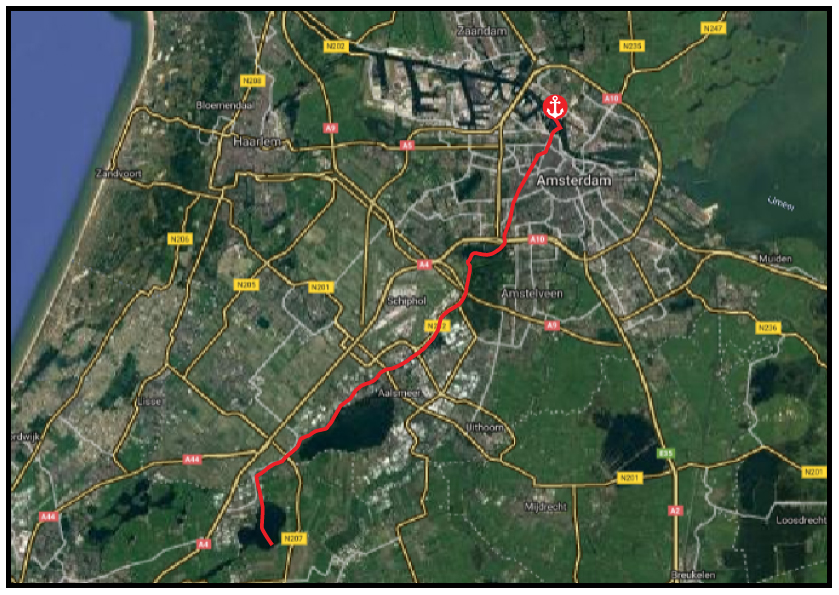
We made it in time for the bridge opening at the Schipholbruggen. These bridges only open 3 times a day due to the busy traffic, so you really don’t want to miss an opening. We even had 20 minutes to spare so we tied up to the waiting dock and made a cup of tea. After the bridges we entered the Nieuwe Meer. The idea to anchor here for a day or two before the night passage through Amsterdam, was cut short. According to the signs we weren’t allowed to anchor here anywhere. That meant we had to do the passage tonight, something we hadn’t anticipated. But as it seemed, nothing went according to plan the last few days. So we tied ourselves to the waiting dock, and tried to catch some sleep before the passage.

When we arrived at the waiting dock we had hailed the control center to state our intention to pass trough Amsterdam with the night convoy. We were given the instruction to listen to channel 69 for further instructions from 23.00h onwards, because the passage would start at 23.56h. Thus after a late dinner we waited for the instructions. But the channel stayed silent, so we hailed them again. Finally a response. The bridge opening would be at 23.55, so we had to be ready in front of the bridge at 23.50 because they had to open 2 motorway bridges and 3 train bridges in one go, which we had to pass within a few minutes. They would hail us for further information.
So we untied at 23.48 and drifted towards the bridge. Silence. Nothing to be heard on the VHF. Finally at 12.10 the bridge started to open and we could pass on to the lock that lies directly behind the 5 bridges.
In the lock we had a few minutes to fully appreciate that we had started our nightly adventure. We were rather nervous since we had never done a night passage before, let alone one through a city notorious for bicycles littering the canal floors, with 15 bridges and one lock.
It was almost new moon, and when we left the lock it was pitch dark. Later on when we entered the inner city it became a lot brighter with all the street lighting, neon signs and illuminated windows. Slowly our nervosity subsided. It was actually all rather exiting. We were very much focused not to hit anything in the dark like the aforementioned submerged bicycles and to time our arrival at the bridges, but all in all we were able to enjoy the passage. Turned out the whole convoy was just us, and the bridges were operated remotely, so all alone we went through the dark canals of Amsterdam.
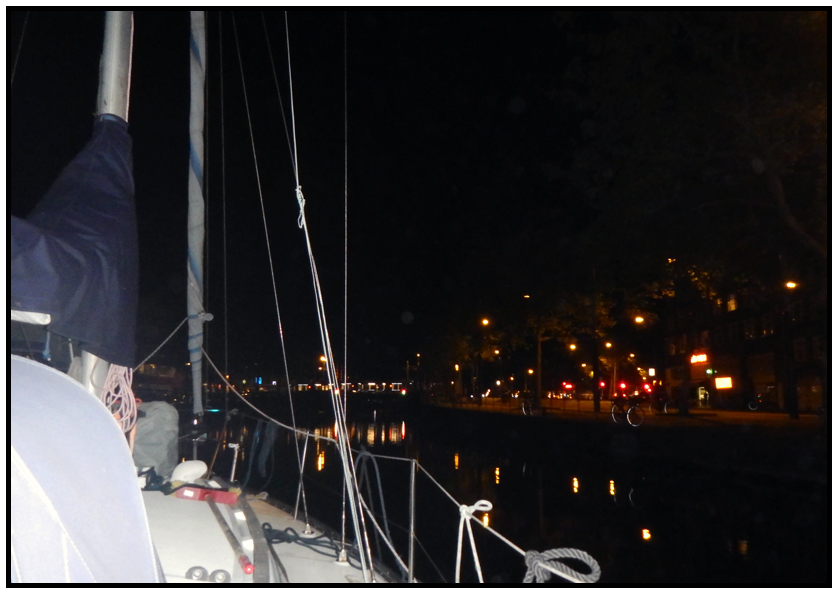
The 14th bridge was another rail bridge. We were supposed to hear the exact time of passage over the VHF, but there was only silence. After 15 minutes we hailed them, and were told that an opening would be arranged shortly. Shortly in Amsterdam apparently means something else than in the rest of the world, because we had to wait for another 20 minutes before the bridge opened.
One last bridge and then we entered the IJ canal, a broad water channel connecting the North Sea with the IJsselmeer. The marina where we were heading was on the other side of the canal, slightly to the left. Leaving all the bright city lights behind us, it became pitch dark again. There was a near miss with a lock pilar in the dark, and we had to maneuver around big wooden dolphins (sort of docking blocks sticking out the water). Normally they have white caps, but these didn’t, rendering them virtually invisible in the dark.
The IJ canal luckily wasn’t busy at all. We saw one other vessel in the distance, so we could safely cross to the other side and enter the marina.
It wasn’t long before we were safely moored in Amsterdam marina. But it took a while before we could sleep with all the excitement of completing our first night passage.