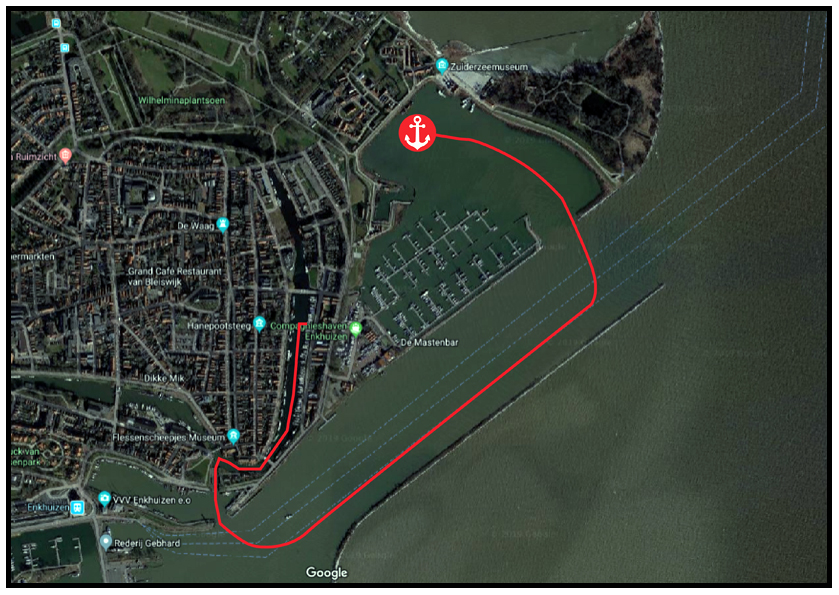
Anchorage Enkhuizen Zuiderzee museum to Enkhuizen Oosterhaven: 1,1 nautical miles
We decided to move back to the municipality marina of Enkhuizen today. The weather would continue to take a turn for the worst with predictions for a south-westerly storm for Friday and Saturday. And honestly we could do with a good night’s sleep. So we’re going to wait out the storm in the shelter of the marina.
Because the wind had changed direction early this morning, the idiot next to us was right on top of our anchor. Slowly we hauled in the chain manually. Lucky for our neighbour the wind shifted a bit, causing the other boat to swing slightly away from our anchor. The anchor had dug in deep, but we managed to wriggle it free with the anchor winch without bumping into the other boat. But frankly we were so fed up with the blundering idiot that we couldn’t have cared less.
When we entered the marina we hailed the harbour master to ask if there was still a spot available in the Oosterhaven, and if possibly slip 51 would still be free. “Ah, sail yacht De Kim! Are you wearing your glasses this time?” he responded. It seems to have become the running gag. For years to come we will be known as the people who docked in the wrong slip because they were not wearing their glasses.
We felt wretched by the lack of sleep and were grateful to be able to dock in a familiar spot. And luckily it was a familiar spot, because the docking didn’t go all too well. Our reactions were so sluggish, that docking in an unfamiliar spot would have been even more disastrous.
We went to the ticket machine and paid the fee for the coming days, bought some fresh bread along the way and spent the day recovering from our anchorage adventure.
Our morning view was still looking pretty agreeable, no sign of thunder and rain.
We both had a poor night’s sleep. Every sound woke us with a start, but fortunately nothing had hit us during the night.
In contradistiction to previous weather forecasts, the wind was going to pick up and the barometer had already dropped significantly. A bad weather front was moving in, with thunder, hail and gusts of wind. Not a good day to go sailing. But should we go back to the marina then? The spot where we were anchored was relatively sheltered from the wind, and the gusts weren’t going to be too severe tonight, so we decided to stay. We were a bit worried about the idiot who was still moored close to us. But if the wind predictions were correct for once, we would end up parallel from each other, so he couldn’t cause much harm.
The weather in the afternoon was still relatively agreeable, but after dinner rain and thunder made their appearance. The wind was howling, the groaning caused by the constant strain on the anchor chain was getting louder and the rain slashed against the windows. There were so many discharges that it almost looked like a sunny day. If a thunderstorm passes over and you’re anchored in a boat, it makes you feel quite small and vulnerable. We sat in the saloon, too anxious to sleep, watching the force of nature at work. On top of that the anchor alarm went off. Not because we were dragging, but only to notify us that the battery of the iPad was low. We were already a bit tense, so the fright of the alarm didn’t really help.
You can imagine that we had yet another sleepless night…
Enkhuizen Oosterhaven to Enkhuizen anchorage Zuiderzee museum: 1,1 nautical miles
Today we left Enkhuizen to anchor in … Enkhuizen. A whopping 1,1 nautical miles further is a nice secluded anchorage in a bay next to the Zuiderzee museum. We had seen it earlier, but it had been so overcrowded during the holiday weekend that we didn’t even bother to try. But all the holiday makers have gone back home, so hopefully it won’t get too busy today.
There were only 3 other boats in the little bay today, enough space to allow us to anchor as well. Everything went according to plan this time. The anchor was set on the first go, we activated the anchor alert app the moment we released the anchor, and we had a perfect position. Not too close to the others and not too far away from the shelter of the embankment.
It was a glorious day. Nice and warm, no wind at all, the perfect weather to enjoy life at anchor. From our cockpit we had a good view on the museum. Funny to look at all the buildings from a different angle. It almost looks as if we were watching the past from our cockpit, were it not for the humans in their brightly coloured branded clothes.
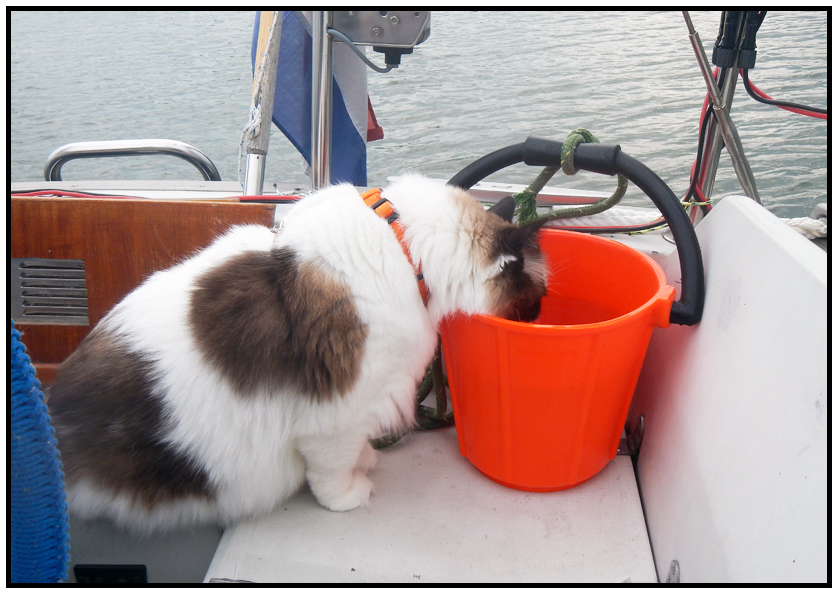
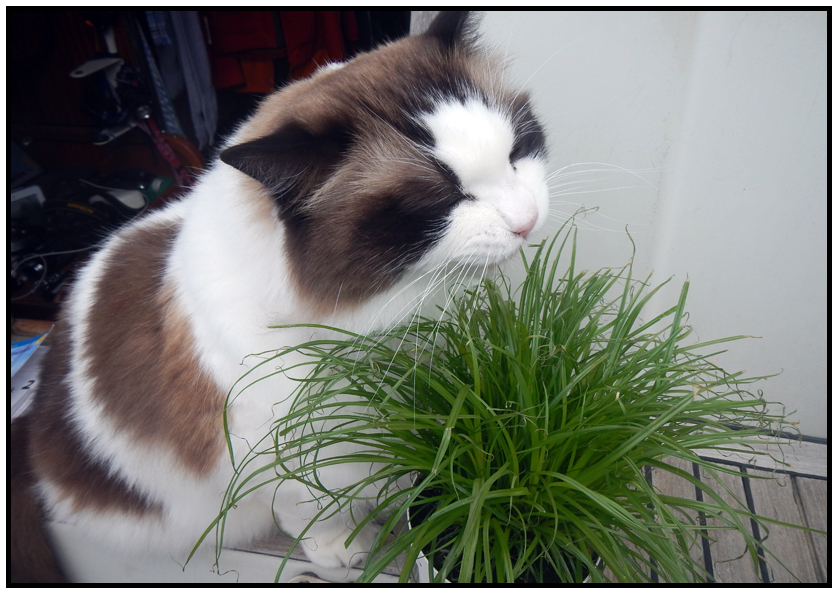
Captain Fluffy is checking the water to extinguish the barbecue
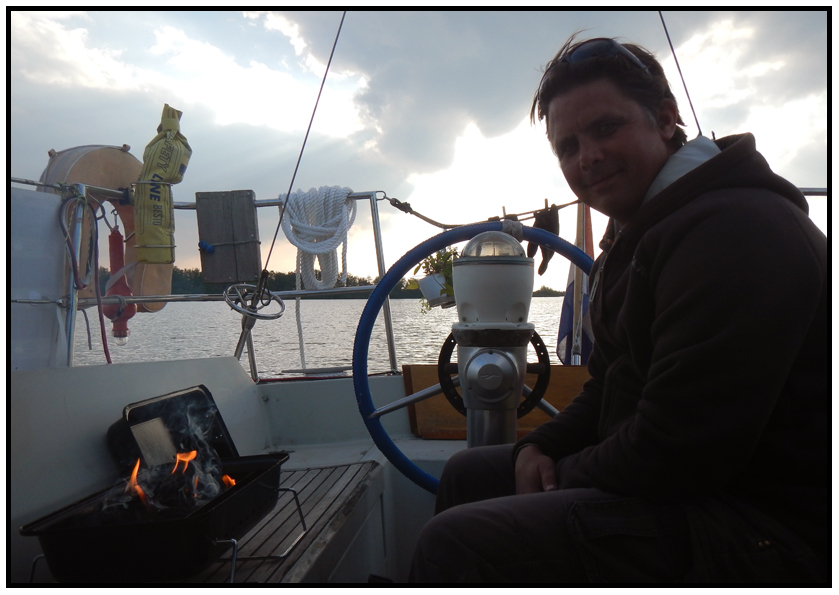
We had a barbecue in the cockpit, and were about to go inside because the wind was picking up and it started to get cold, when an idiot was anchoring almost on top of us. We called out to him to ask what he thought he was doing. The wind direction was going to change, and then revert back again tonight, so we urged him to at least give more anchor line so we wouldn’t get entangled during the night. Why do people do that? There was enough space elsewhere, but he had to anchor just one boat length away. The sun was setting, the wind started to turn and the other boat was really getting too close for comfort. Should we lift the anchor and relocate? What if the other boat would start to drag and dislodge our anchor? What if he would hit us during the night? The guy in the other boat obviously wasn’t concerned at all. We saw him extinguish the lights to assumedly go to sleep. From what we could judge in the dark, we both had just enough space to turn around our axis. So technically it shouldn’t be a problem, if we both wouldn’t start dragging. But since we are so inexperienced the whole situation was quite disconcerting.
The weather is changing and the barometer is plummeting like a rock. Time to move today because tomorrow the wind is going to increase even more and it will start to rain. Despite our worries of the last days our anchor had set well. We could tell it had dug in really deep, because when the last shackles and the anchor surfaced it was covered in such a thick layer of clay that we could provide for a whole pottery.
We had also dragged up pieces of pond weed (Potamogeton), common water plants for this area that in summer grow so fast that the authorities need to mow them to enable boats to move. But it is still springtime so hopefully the growth isn’t that severe yet. As the plants appear to be edible we probably need to graze our way through the Markermeer in summertime.
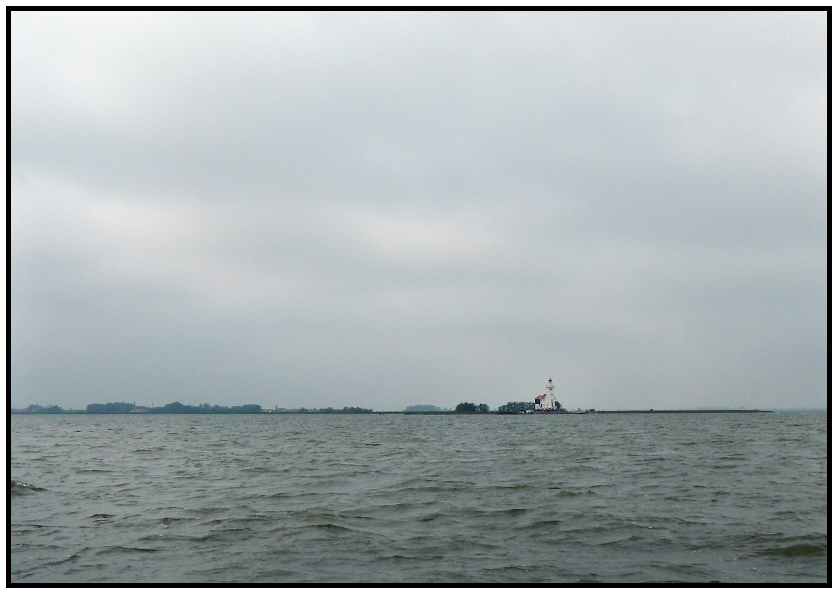
The Horse of Marken in the distance
The wind was perfect for sailing, thus after hauling in the anchor we hoisted all the sails and headed towards Edam. We made good speed, and soon rounded the Horse of Marken, a historic lighthouse built in 1839 on the former island. Although heavily overcast, it was quite an enjoyable sail. Later in the afternoon the wind started to increase steadily, and before long it had increased to wind force 4 with gusts of 5 and was still increasing. All the other sailboats were heading towards shore, and soon we were the only boat left on the water. But we were already approaching the entrance to the marina of Edam, so we took down the sails and traversed the last bit by engine.
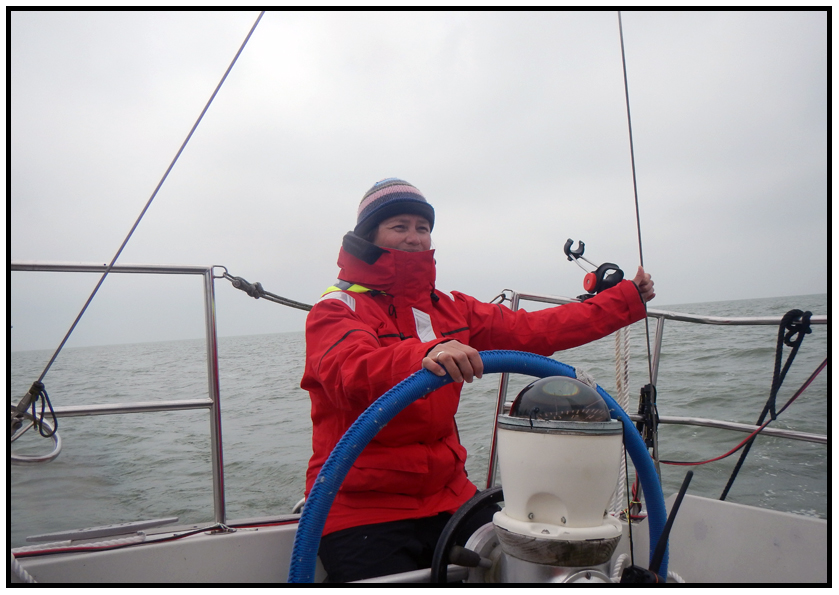
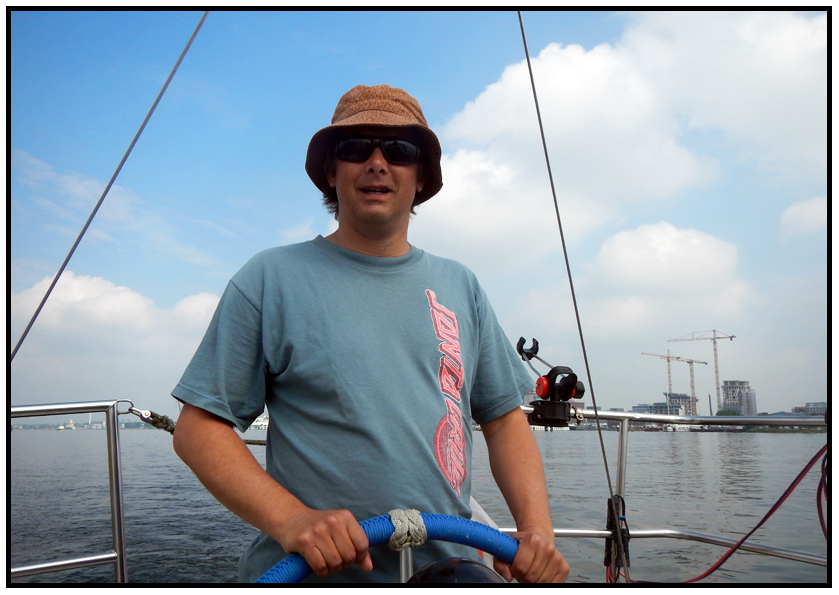
Carmen at the helm
The harbour entrance was a bit shallow for our draft, but we docked in the marina of W.S.V. De Zeevang without difficulties. What proved to be difficult was getting electricity. Just like in Leiden, there are poles with sockets in which you have to insert €0,50 to get electricity. But after trying two sockets and loosing 2 coins we decided that this is a problem for tomorrow.
At 3 in the morning the anchor alarm went off again. But after checking the anchor itself and the coordinates of our position, it looked like we were still more or less in the same spot. Confusticate and bebother this dratted alarm! Whatever could be the reason for it to go off without reason? We were confident that it had to be false alarm, but it is not really pleasant to wake up to the sound of a diabolical alarm going off.
We tried to analyze what could have caused the alarm to go off. In the morning light we checked our position in relation to the shore. Judging by the visual reference points we hadn’t moved. If we had been dragging, it couldn’t have been much. So if we hadn’t been dragging what then? Our deduction was that it could have something to do with the timing of activating the anchor watch app. How the app works is that it uses GPS coordinates to mark the spot where you drop the anchor and then draw a circle -for example 25 meters in diameter- around that spot. Then you move back and let out anchor chain, depending on the depth, the current and the wind. You can see the position of the boat as a dot in the circle. So you can pivot around your anchor in all directions, as long as you stay within the circle all is well. If you start to drag and the dot representing the boat moves out of the circle, the alarm goes off. This works perfectly well if you activate the app at the exact moment you drop the anchor. But if you drop the anchor, move backwards to let out 20 meters of chain and then set the alarm, it draws a circle around the GPS coordinates of your boat, and not the anchor. With 20 meters of chain and a circle of 25 meters diameter the anchor would actually lie somewhere near to the edge of the circle. In this case the wind had shifted 45 degrees, causing the boat to pivot around the anchor and thus moving it out of the circle. We figured that this might have caused the alarm to go off, because when checking our gps coordinates and the visual reference points we were still at the same spot. Next time we should set the alarm at the moment we drop the anchor, or note the GPS coordinates, and not 5 minutes later.
You often read that you must develop a relationship of trust with your anchor. So we tried to relax and put faith in our anchor. It helped that the sun was shining because everything looks a lot better in the sun. We ended the day with the conclusion that we had set the anchor properly and made the right decision to stay. Enough reason to celebrate with a barbecue in the cockpit.
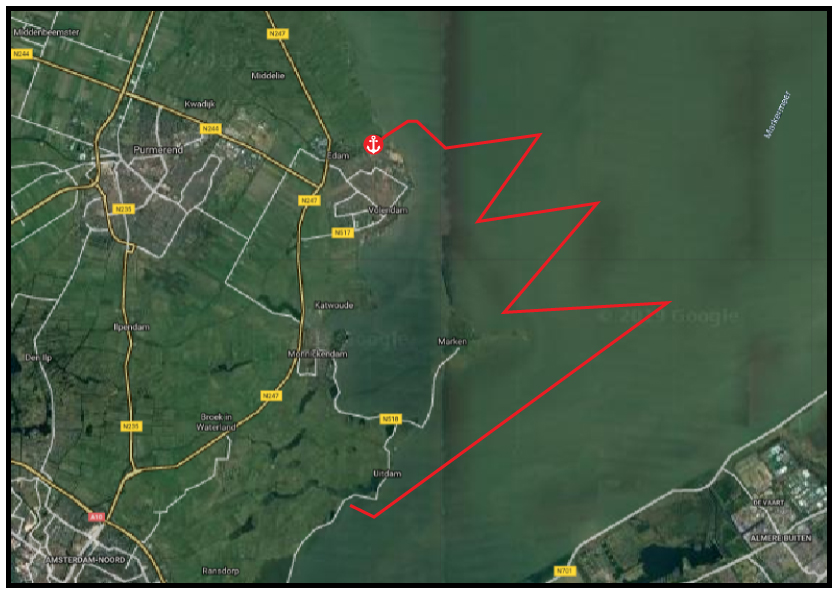
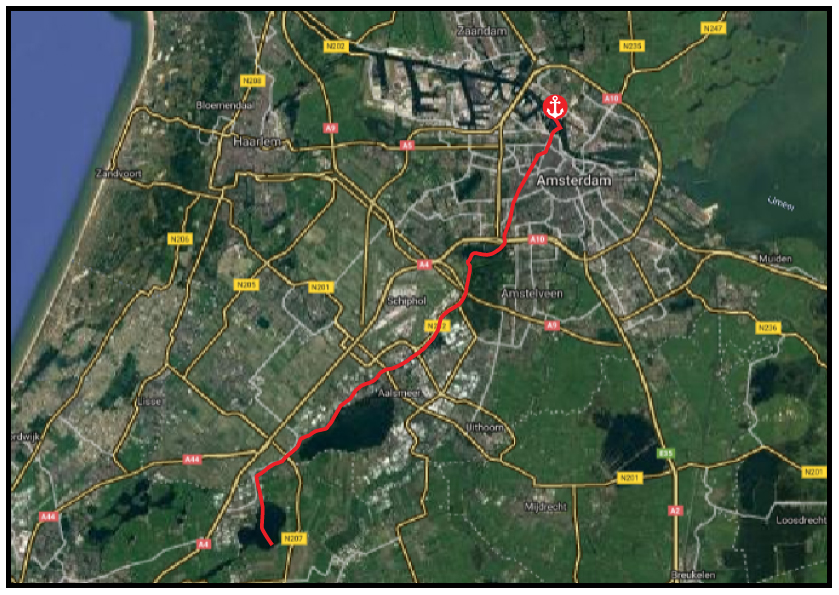
Amsterdam to anchorage near Uitdam: 9,2 nautical miles
Time to leave the capital and continue north. First we had the follow the IJ-canal (IJ is an old Dutch word for water) past Amsterdam Central train station.That meant zigzagging through canal boats, dodging ferries and big barges and keeping a lookout for small motorboats with crying children, fussing grannies and lounging parents at the same time. The ferries are not too bad, but the canal boats are under the impression that because they’re professional traffic, they have the right to ignore basic rules and behave like jerks.
Looks almost like a painting from the Romantic period
After a chaotic trip down the IJ-canal we finally reached the Oranje locks. It had just closed so we moored to the waiting dock and awaited our turn. Since they have 3 locks here for pleasure crafts it wasn’t long before we could enter another. Right after we had cleared the lock we were faced with the Schellingwouder bridge, which was closed and wouldn’t open for another 25 minutes. Strangely in contrast to the Oranje locks that run every 10 minutes, there were no waiting docks here. The stretch of water in between the locks and the bridge is like a small turbulent basin of water caused by the large barges and speed boats that can pass under the bridge without an opening. Nothing to it than treading water and dodging barges and wait for the bridge to open.
Zigzagging through the IJ canal
After 20 minutes we finally entered the Markermeer, a closed-of part of the IJsselmeer. The plan was to find a nice quiet spot to anchor after 10 days in Amsterdam. Friends had given us tips where to anchor, but unfortunately our draft was way too deep for those locations. Slowly we progressed north, heading towards a spot we had seen on the map that might offer some shelter from the wind and waves.
When we finally arrived at the spot it looked promising. Not as idyllic as we had imagined, but quiet and away from the crowds. We dropped the anchor, activated the anchor alarm app and checked the visual reference points for 5 minutes. No movement, hopefully the anchor has successfully set. The sun was shining abundantly so we spend a lovely afternoon in the cockpit enjoying the peace and quiet.
In the evening the wind picked up and started to change direction. But since we knew that was going to happen we had taken the rotation into account when dropping the anchor. Everything still looked okay, so we were reasonably confident that we had done a good job. But right before we wanted to go to sleep, the anchor alarm went off. You can imagine that shook our confidence. What had happened? Didn’t we read the position correctly before? Could the anchor be dragging due to the change in wind direction? We were wondering if hoisting the anchor and reset it was the right thing to do. And if we wanted to reset the anchor, this might be the right time since it wasn’t dark yet and we could still see what we’re doing. But on the other hand we were quite confident that the anchor had set properly. While we were discussing what to do it slowly had become dark, and the anchor alarm had gone off yet again. The unnerving alarm was not really boosting the already brittle confidence we had in our anchoring skills. In the end we agreed that we would not re-set our anchor and stay in this spot to see if we’ve done it correctly. We’d rather not sleep and reset the anchor in the night than move now and forever doubt if we had done it correctly. And we had reasonably light winds and nothing in the vicinity that we could hit, so we could intervene quickly when dragging. So we took the decision to trust our gut feeling and ignore the alarm. Time will tell if we have taken a foolish gamble.
Anchorage Braassemermeer to Amsterdam: 18 nautical miles
We were rudely awakened this morning by a clashing sound, followed by the anchor alarm going off. Apparently we were dragging, so we jumped out of bed to check on the anchor. We had indeed been dragging, but fortunately not much. But the wind direction had shifted and a quick check on the weather forecast told us that the wind would turn 180 degrees and increase to wind force 5 when a thunderstorm would pass over. Yesterday when we checked the weather forecast the wind would continue to blow from the east, and although rain was predicted, nothing was said about thunder and lightning. Well, you know what they say, nothing as unpredictable as the weather. No wonder our anchor was dragging. It probably didn’t have any grip in the slushy peat bottom.
What shall we do now? Reset the anchor or continue to Amsterdam? The next stage would lead us to the Nieuwe Meer lock, the start of the nightly passage. But then we would have to leave within 15 minutes otherwise we would miss the bridge opening over the A9 motorway near Schiphol at 12.30 hours. We had planned to stay here for 2 or 3 days so we weren’t expecting to be faced with this decision right now. Choices, choices. And we had to decide quickly, because we were still dragging. And all that on an empty stomach and without a drop of coffee.
We made the decision to hoist the anchor and continue to Amsterdam. We quickly put on our sail gear -in the meantime it had already started to rain- pulled the anchor out of the sludge and continued to Amsterdam.
We past another big stretch of water, the Westeinderplassen. Initially we wanted to anchor there as well, but the whole lake is even more shallow than the Braassemermeer. And we didn’t feel like repeating yesterday’s close encounter with the ground again. But definitely a beautiful place to go to if you have a boat with less draft. This lake and the Braassemermeer, where we were yesterday, all used to be peat bogs. After they had dug out the peat these lakes with their tiny islands and small drainage canals were left. You can moor between the high reeds or at the tiny islands. But alas, not for us. Onward we went through the drizzling rain.
Suddenly the depth meter jumped from 2,5 to 1,4 meter! A submerged bump in the waterway! The boat lurched back and then catapulted forward like we were being launched over a ramp. These are truly the days of insufficient depths…
We made it in time for the bridge opening at the Schipholbruggen. These bridges only open 3 times a day due to the busy traffic, so you really don’t want to miss an opening. We even had 20 minutes to spare so we tied up to the waiting dock and made a cup of tea. After the bridges we entered the Nieuwe Meer. The idea to anchor here for a day or two before the night passage through Amsterdam, was cut short. According to the signs we weren’t allowed to anchor here anywhere. That meant we had to do the passage tonight, something we hadn’t anticipated. But as it seemed, nothing went according to plan the last few days. So we tied ourselves to the waiting dock, and tried to catch some sleep before the passage.
Waiting for the bridges and lock to open at 23.56h
When we arrived at the waiting dock we had hailed the control center to state our intention to pass trough Amsterdam with the night convoy. We were given the instruction to listen to channel 69 for further instructions from 23.00h onwards, because the passage would start at 23.56h. Thus after a late dinner we waited for the instructions. But the channel stayed silent, so we hailed them again. Finally a response. The bridge opening would be at 23.55, so we had to be ready in front of the bridge at 23.50 because they had to open 2 motorway bridges and 3 train bridges in one go, which we had to pass within a few minutes. They would hail us for further information.
So we untied at 23.48 and drifted towards the bridge. Silence. Nothing to be heard on the VHF. Finally at 12.10 the bridge started to open and we could pass on to the lock that lies directly behind the 5 bridges.
In the lock we had a few minutes to fully appreciate that we had started our nightly adventure. We were rather nervous since we had never done a night passage before, let alone one through a city notorious for bicycles littering the canal floors, with 15 bridges and one lock.
It was almost new moon, and when we left the lock it was pitch dark. Later on when we entered the inner city it became a lot brighter with all the street lighting, neon signs and illuminated windows. Slowly our nervosity subsided. It was actually all rather exiting. We were very much focused not to hit anything in the dark like the aforementioned submerged bicycles and to time our arrival at the bridges, but all in all we were able to enjoy the passage. Turned out the whole convoy was just us, and the bridges were operated remotely, so all alone we went through the dark canals of Amsterdam.
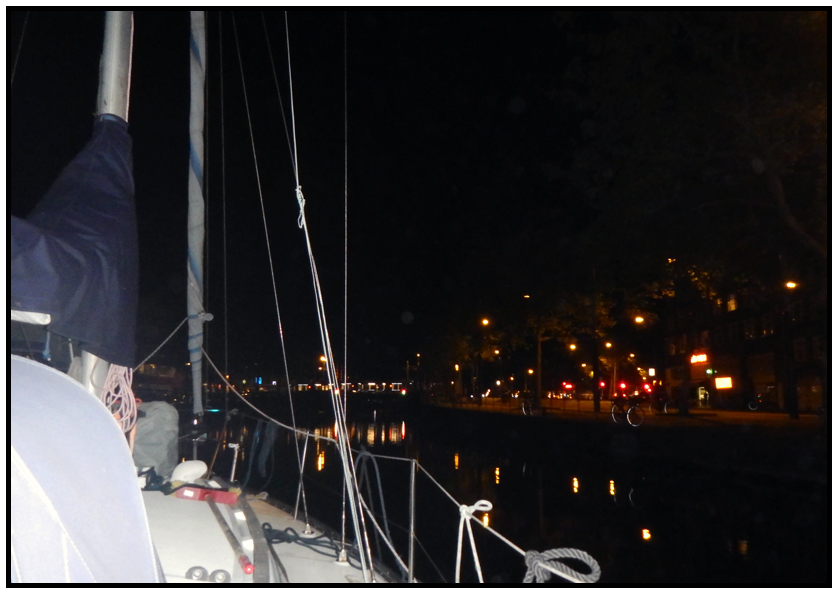
The nightly passage through Amsterdam
The 14th bridge was another rail bridge. We were supposed to hear the exact time of passage over the VHF, but there was only silence. After 15 minutes we hailed them, and were told that an opening would be arranged shortly. Shortly in Amsterdam apparently means something else than in the rest of the world, because we had to wait for another 20 minutes before the bridge opened.
One last bridge and then we entered the IJ canal, a broad water channel connecting the North Sea with the IJsselmeer. The marina where we were heading was on the other side of the canal, slightly to the left. Leaving all the bright city lights behind us, it became pitch dark again. There was a near miss with a lock pilar in the dark, and we had to maneuver around big wooden dolphins (sort of docking blocks sticking out the water). Normally they have white caps, but these didn’t, rendering them virtually invisible in the dark.
The IJ canal luckily wasn’t busy at all. We saw one other vessel in the distance, so we could safely cross to the other side and enter the marina.
It wasn’t long before we were safely moored in Amsterdam marina. But it took a while before we could sleep with all the excitement of completing our first night passage.
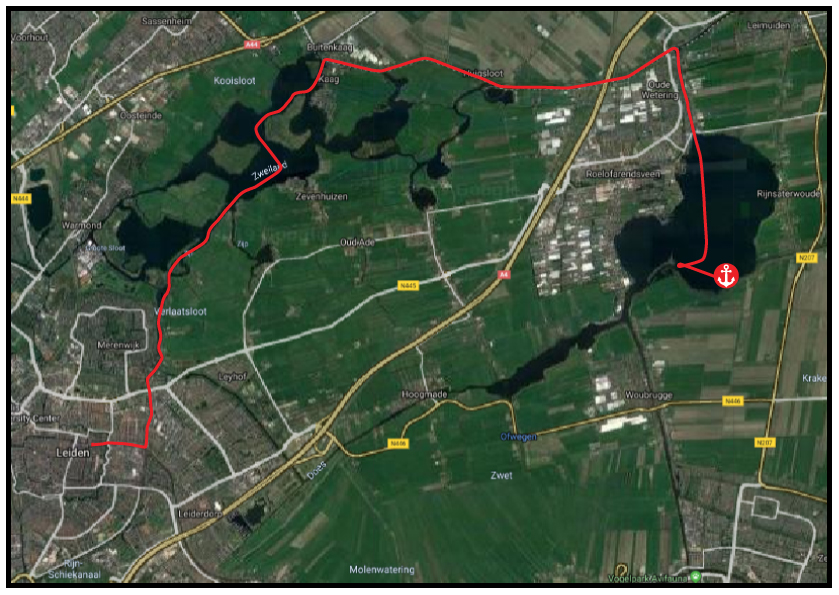
Leiden to anchorage Braassemermeer: 10,8 nautical miles
Today we really are leaving Leiden. It was raining, which was actually rather fitting because we had such a good time here. Not many bridges today, just six. And most of them we had already passed in Leiden. There used to be a time that the prospect of negotiating only one bridge would have caused a lot of stress. But now we’re already talking about ‘just six bridges’. It seems like we have learned a lot.
After Leiden we passed the Kager Plassen, a cluster of bigger and smaller lakes where Jeroen had learned to sail and windsurf many many years ago. It was quite shallow everywhere and the waterway wasn’t clearly indicated either, so we had to keep a close eye on the depth meter. At the end of the Kager Plassen you can choose to either go left to Haarlem or right to Amsterdam. And as decided yesterday, we went right.
The rain was starting to increase, but despite the rain it was actually a pleasant trip. The nice thing about smaller inland waterways and sparse traffic, is that there are hardly any waves, so we could make ourselves a steaming mug of tea along the way to keep warm.
Disco in the drizzle
We were heading for the Braassemermeer where we found a sheltered mooring spot surrounded with trees and a place to barbecue. Although it was still raining now, the sun would come out at the end of the afternoon. So we pictured ourselves sitting there enjoying the warmth of the fire in the fading sunlight. We saw the entrance to the mooring, and made sure to head straight for the middle of the opening, because we had read somewhere that it was a bit shallow to the sides. The middle part was supposed to be two meters deep, and our draft is 1 meter 73, so we should be okay. Nevertheless we again kept a close eye on the depth meter. 2 meters, 1 meter 90 …careful now, 1 meter 80 … okay, were still moving, 1 meter 70 …what? 1 meter 70? 1 meter 40! We’re stuck!! We frantically thrusted backwards and left to right, trying to wriggle free from the peat on the bottom of the lake. A few stressful minutes later we were free again, and quickly backed away. Apparently mooring here is not meant to be.
We decided to find a spot on the leeward side of the lake to anchor. Well, leeward…. there was hardly any wind at all, making it actually more difficult than the last time when we had too much wind. In the first attempt we backed away too slow, causing the chain to fall on a big heap in the peat. When we hauled the chain and anchor in, it was coated in a thick and smelly layer of goo. Yuk. A second attempt. This time we gave more thrust when moving backwards, and that worked.
Anchor watch app on, check landmarks and hope for the best. There was no significant current and next to no wind, so would probably stay put in the same spot without anchoring.
It is really beautiful and quiet here, you only hear birds singing. We spend a peaceful afternoon waiting for the rain to subside, watching the birds and enjoying the surroundings. We had planned to test the new barbecue this evening, but we were rather far from the shore. But with a few safety measures we managed to do it in the cockpit and had a wonderful dinner in the warm glow of the barbecue. And despite rain and the close encounter with the bottom of the lake, it had been a great day.
Anchorage near Hellevoetsluis to Rhoon: 16,1 nautical miles
When we woke up it was still quite windy. It was blowing a steady 18 knots, so we decided to hoist anchor and leave for Rhoon. Now I’m sure that all you experienced salty sailors would do it in a jiffy, but for us hoisting an anchor with wind force 4 to 5 is something to be a bit nervous about. Before our worries concerned an anchor that would break free. Now we were concerned that we couldn’t get it out. In theory you should slowly sail towards your anchor which makes it easier to haul it in. Slowly we eased forward and started to haul in the chain, but keeping the boat from drifting over the anchor is not that easy when the reality doesn’t look a bit like the YouTube ‘how to’ movies with calm waters and sunshine. Despite all the waves and the wind we managed to get the anchor aboard and set course for Rhoon. We had head winds and it was still blowing an average of 18 knots so no sailing today unfortunately.
The Haringvliet is quite broad, and our position now being the lee shore (the side where the wind is blowing towards for all you landlubbers:) the wind waves were creating a bumpy ride. So we were happy to leave the Haringvliet and enter the Spui, a smaller more sheltered water way that lead towards Rhoon.
We passed little towns and typical Dutch landscapes with windmills -the modern versions- and the obligatory sheep and cows.
After a relatively uneventful trip we arrived in the marina of Rhoon. The sun was peeping through the clouds again so we relaxed a bit in the cockpit and enjoyed the remainder of the sunshine.
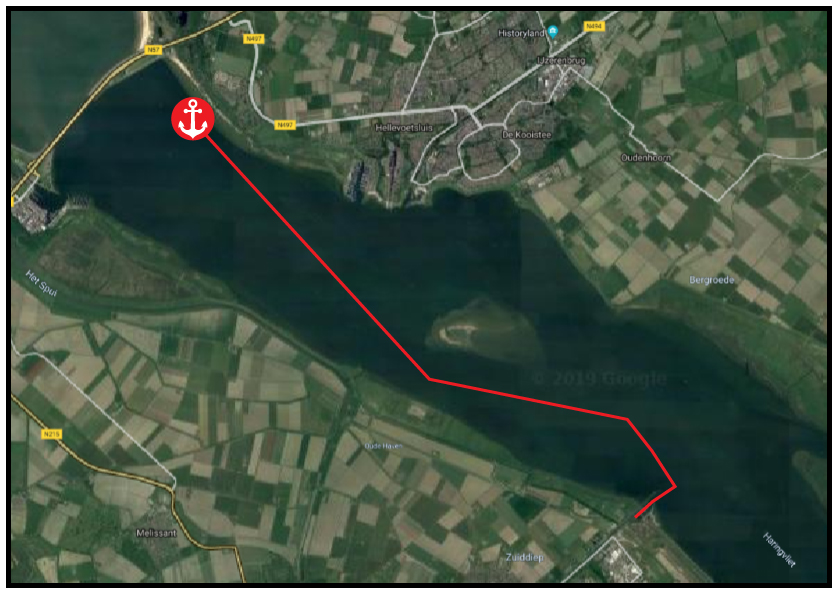
Middelharnis to anchorage near Hellevoetsluis: 6 nautical miles
Today it was time to leave again.
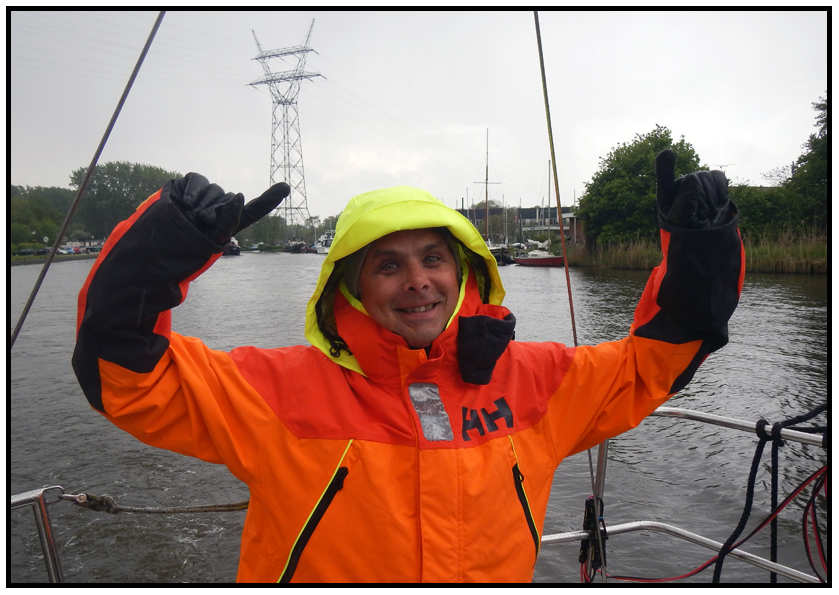
The newly installed lamp had started to have a mind of its own during the night, switching on and off on its own account. So Jeroen dismantled the whole thing during the night. Something to look into another time.
Around noon we untied the lines and left Middelharnis. We had favourable winds and the jib was working again so we decided to sail to Hellevoetsluis where we had planned to anchor. In the meantime we noticed that the transducer was still not working. Had we put it back the wrong way round? Another chore back on the to-do list again…
Although we felt that it was time to continue our journey, it was actually a bit hard to leave. We really felt at home there in that little marina. Even Captain Fluffy enjoyed himself there, frolicking in the high grass. We now understand what a friend of ours meant when she said that you should take your time when you travel. Not only to enjoy every moment and not to over hasten things, but also time to say goodbye. Naively we thought that we only had to say goodbye when we started our journey. We hadn’t realized that travelling is not only discovering new things, but also saying goodbye over and over again.
After a nice sail we approached the spot we had picked to anchor. It was the first time ever anchoring for us, so we experienced a fair bit of anxiety. We wanted to try the anchor in a familiar place first, so we picked a spot in an area we knew, that was relatively sheltered, and if we would be so unfortunate to break loose that we wouldn’t crash into something immediately.
Engine on, sails down, time to anchor!
After sailing towards the wind first, we backed away slowly mostly by the force of the wind, dropping the anchor at the same time. The depth was 5.7 meter , so we lowered 30 meters of chain which would presumably be enough for wind force 3 to 4. It seemed like the anchor was holding, so we shut down the engine. Fingers crossed! We wrote down the GPS coordinates and started a anchor watch app that we had recently downloaded. The app causes an alert to go off when the position of the anchor changes.
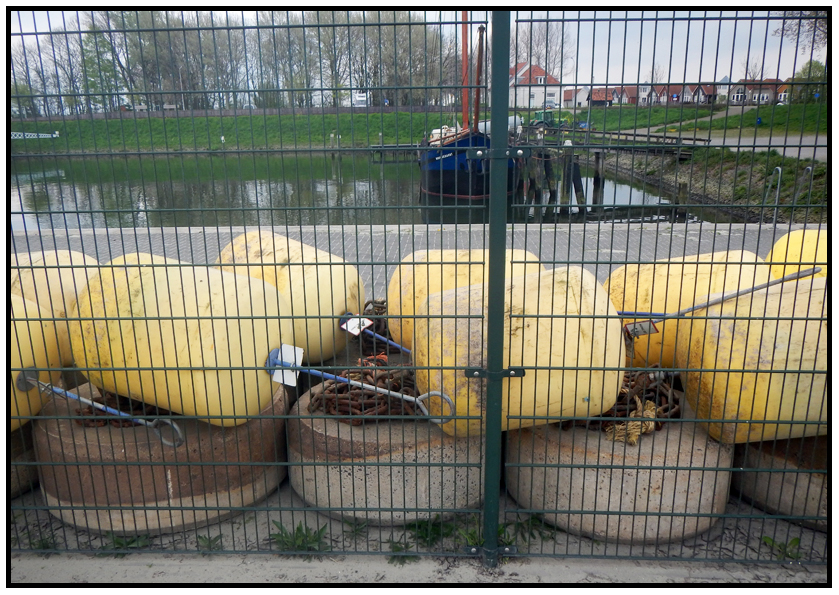
We had used mooring buoys before, but never an anchor. We always thought that they were preferable above an anchor, because they looked so sturdy and seemed safe to use. But on the internet you can find a fair bit of warnings against those mooring buoys, that in fact they aren’t safe at all, especially with high winds. And you never know for sure when they were last checked or hauled out for maintenance, so they might be in a dodgy state. Here in the Netherlands they take the mooring buoys out of the water in winter for maintenance, in that sense their durability is checked regularly. The buoys were still on the hard in the depot when we were in Middelharnis because it was still early in the season. And actually it was rather unsettling to see how small the concrete blocks were to which the buoys were attached. We now can imagine that they wouldn’t be able to hold the weight of a sailboat in a storm.
The mooring buoys with their concrete blocks on the hard
It was still quite warm and a refreshing dive would be welcome, but the water temperature was still around 13 degrees Celsius. Way too cold for a swim. But fear not! There is always a solution. We had bought a solar shower, an filled it up yesterday with the intention to try it out. But we has completely forgotten all about it, until this moment. So we got out the soap and tried the shower. It might need some tweaking, but it works reasonably well. It holds 20 liters of water, but we hadn’t even used half of it.
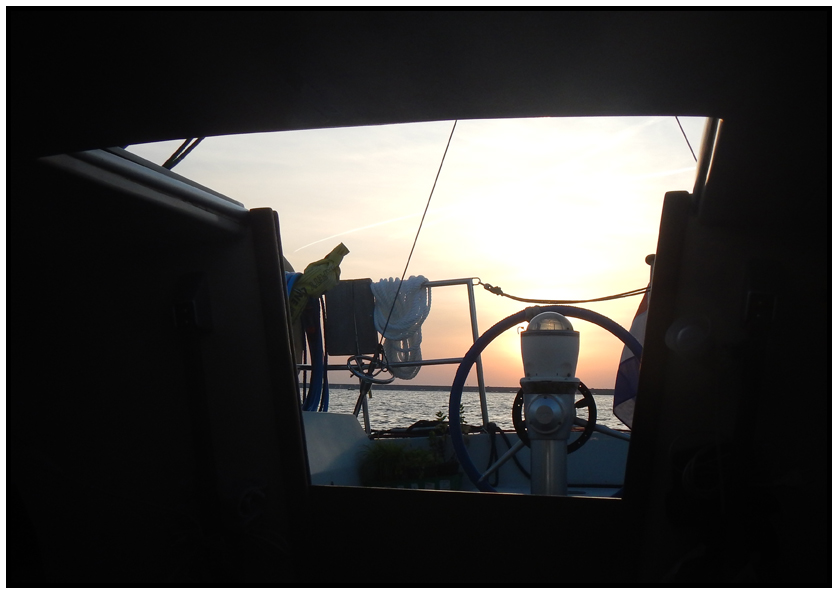
A view of our first sunset at anchor
Refreshed by the shower we had a lovely dinner with asparagus when the wind started to pick up. The forecasted 3 Beaufort turned out to have become a steady 4 with gusts up to 5. As we were still a bit nervous about our first time ever anchoring, and the app was a bit dodgy, we installed 2 more anchor watch apps to notify us if we were dragging.
The wind was increasing ever more, so when we went to bed it felt more like being in a cocktail shaker than a comfy v-berth. Captain Fluffy was also not amused and jumped up with every big jolt. And with every crash or creak there’s this little voice in your head that says “are you sure we’re still securely anchored? You can imagine that we didn’t have a good night’s sleep…