Anchorage Kooizand Enkhuizen to Oosterhaven Enkhuizen: 1,6 nautical miles
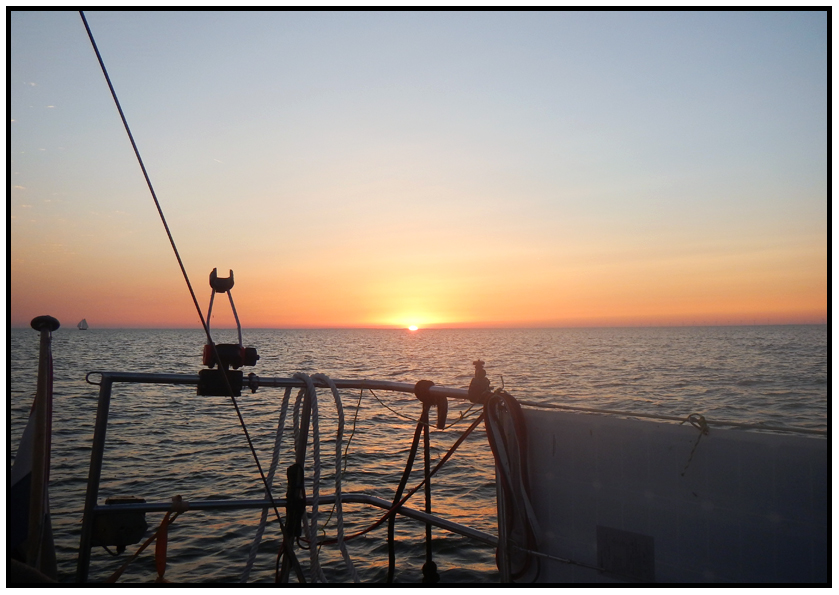
We were woken early by being jolted hither and thither by the waves. The wind direction had changed, but the waves were still coming from the same angle from which the wind blew before. And it was blowing much harder than forecasted. Oh well…the unpredictability of the weather. We tied everything up that was flapping about and were just in time to see a beautiful sunrise.
One of the first sunrises we’ve seen from our boat
Since it was quite early we tried to catch some more sleep. When we woke again it was blowing even harder and from another direction than predicted. We chose the spot because the wind was supposed to turn from easterly to south-westerly during the night. But now it was more northerly, causing us to be exposed to the waves and the wind. On top of that we were also dragging a bit, probably because the wind had turned 180 degrees, or that the chain we had let out wasn’t long enough for the increased wind and waves. But first things first: we were not going to leave without breakfast and some coffee first like we did at the Braassemermeer. The coffee was made with the very last drops of water. We had just managed to stretch our water supply to nine days.
From the anchorage it was just a short distance to the Oosterhaven. When we hailed the harbour master about an available slip, he said that I didn’t need my glasses this time because it was a familiar spot. Still the running gag…
After filling up the water tank, connecting shore power and all the other usual mooring stuff we went to the ticket machine to pay the fee. We treated ourselves to a nice lunch with soles and fries, bought some bread on the way back and spend a relaxed afternoon on the boat.
Our morning view was still looking pretty agreeable, no sign of thunder and rain.
We both had a poor night’s sleep. Every sound woke us with a start, but fortunately nothing had hit us during the night.
In contradistiction to previous weather forecasts, the wind was going to pick up and the barometer had already dropped significantly. A bad weather front was moving in, with thunder, hail and gusts of wind. Not a good day to go sailing. But should we go back to the marina then? The spot where we were anchored was relatively sheltered from the wind, and the gusts weren’t going to be too severe tonight, so we decided to stay. We were a bit worried about the idiot who was still moored close to us. But if the wind predictions were correct for once, we would end up parallel from each other, so he couldn’t cause much harm.
The weather in the afternoon was still relatively agreeable, but after dinner rain and thunder made their appearance. The wind was howling, the groaning caused by the constant strain on the anchor chain was getting louder and the rain slashed against the windows. There were so many discharges that it almost looked like a sunny day. If a thunderstorm passes over and you’re anchored in a boat, it makes you feel quite small and vulnerable. We sat in the saloon, too anxious to sleep, watching the force of nature at work. On top of that the anchor alarm went off. Not because we were dragging, but only to notify us that the battery of the iPad was low. We were already a bit tense, so the fright of the alarm didn’t really help.
You can imagine that we had yet another sleepless night…
At 3 in the morning the anchor alarm went off again. But after checking the anchor itself and the coordinates of our position, it looked like we were still more or less in the same spot. Confusticate and bebother this dratted alarm! Whatever could be the reason for it to go off without reason? We were confident that it had to be false alarm, but it is not really pleasant to wake up to the sound of a diabolical alarm going off.
We tried to analyze what could have caused the alarm to go off. In the morning light we checked our position in relation to the shore. Judging by the visual reference points we hadn’t moved. If we had been dragging, it couldn’t have been much. So if we hadn’t been dragging what then? Our deduction was that it could have something to do with the timing of activating the anchor watch app. How the app works is that it uses GPS coordinates to mark the spot where you drop the anchor and then draw a circle -for example 25 meters in diameter- around that spot. Then you move back and let out anchor chain, depending on the depth, the current and the wind. You can see the position of the boat as a dot in the circle. So you can pivot around your anchor in all directions, as long as you stay within the circle all is well. If you start to drag and the dot representing the boat moves out of the circle, the alarm goes off. This works perfectly well if you activate the app at the exact moment you drop the anchor. But if you drop the anchor, move backwards to let out 20 meters of chain and then set the alarm, it draws a circle around the GPS coordinates of your boat, and not the anchor. With 20 meters of chain and a circle of 25 meters diameter the anchor would actually lie somewhere near to the edge of the circle. In this case the wind had shifted 45 degrees, causing the boat to pivot around the anchor and thus moving it out of the circle. We figured that this might have caused the alarm to go off, because when checking our gps coordinates and the visual reference points we were still at the same spot. Next time we should set the alarm at the moment we drop the anchor, or note the GPS coordinates, and not 5 minutes later.
You often read that you must develop a relationship of trust with your anchor. So we tried to relax and put faith in our anchor. It helped that the sun was shining because everything looks a lot better in the sun. We ended the day with the conclusion that we had set the anchor properly and made the right decision to stay. Enough reason to celebrate with a barbecue in the cockpit.
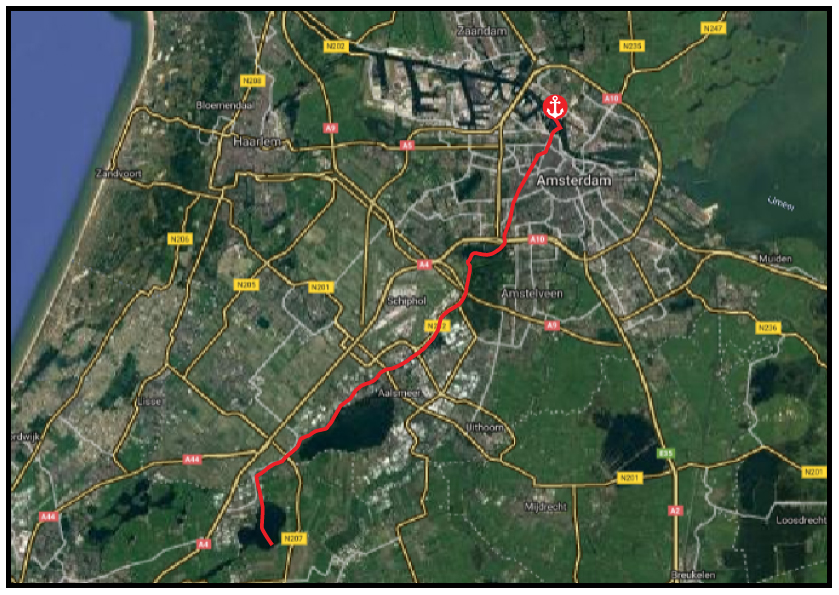
Amsterdam to anchorage near Uitdam: 9,2 nautical miles
Time to leave the capital and continue north. First we had the follow the IJ-canal (IJ is an old Dutch word for water) past Amsterdam Central train station.That meant zigzagging through canal boats, dodging ferries and big barges and keeping a lookout for small motorboats with crying children, fussing grannies and lounging parents at the same time. The ferries are not too bad, but the canal boats are under the impression that because they’re professional traffic, they have the right to ignore basic rules and behave like jerks.
Looks almost like a painting from the Romantic period
After a chaotic trip down the IJ-canal we finally reached the Oranje locks. It had just closed so we moored to the waiting dock and awaited our turn. Since they have 3 locks here for pleasure crafts it wasn’t long before we could enter another. Right after we had cleared the lock we were faced with the Schellingwouder bridge, which was closed and wouldn’t open for another 25 minutes. Strangely in contrast to the Oranje locks that run every 10 minutes, there were no waiting docks here. The stretch of water in between the locks and the bridge is like a small turbulent basin of water caused by the large barges and speed boats that can pass under the bridge without an opening. Nothing to it than treading water and dodging barges and wait for the bridge to open.
Zigzagging through the IJ canal
After 20 minutes we finally entered the Markermeer, a closed-of part of the IJsselmeer. The plan was to find a nice quiet spot to anchor after 10 days in Amsterdam. Friends had given us tips where to anchor, but unfortunately our draft was way too deep for those locations. Slowly we progressed north, heading towards a spot we had seen on the map that might offer some shelter from the wind and waves.
When we finally arrived at the spot it looked promising. Not as idyllic as we had imagined, but quiet and away from the crowds. We dropped the anchor, activated the anchor alarm app and checked the visual reference points for 5 minutes. No movement, hopefully the anchor has successfully set. The sun was shining abundantly so we spend a lovely afternoon in the cockpit enjoying the peace and quiet.
In the evening the wind picked up and started to change direction. But since we knew that was going to happen we had taken the rotation into account when dropping the anchor. Everything still looked okay, so we were reasonably confident that we had done a good job. But right before we wanted to go to sleep, the anchor alarm went off. You can imagine that shook our confidence. What had happened? Didn’t we read the position correctly before? Could the anchor be dragging due to the change in wind direction? We were wondering if hoisting the anchor and reset it was the right thing to do. And if we wanted to reset the anchor, this might be the right time since it wasn’t dark yet and we could still see what we’re doing. But on the other hand we were quite confident that the anchor had set properly. While we were discussing what to do it slowly had become dark, and the anchor alarm had gone off yet again. The unnerving alarm was not really boosting the already brittle confidence we had in our anchoring skills. In the end we agreed that we would not re-set our anchor and stay in this spot to see if we’ve done it correctly. We’d rather not sleep and reset the anchor in the night than move now and forever doubt if we had done it correctly. And we had reasonably light winds and nothing in the vicinity that we could hit, so we could intervene quickly when dragging. So we took the decision to trust our gut feeling and ignore the alarm. Time will tell if we have taken a foolish gamble.
Anchorage Braassemermeer to Amsterdam: 18 nautical miles
We were rudely awakened this morning by a clashing sound, followed by the anchor alarm going off. Apparently we were dragging, so we jumped out of bed to check on the anchor. We had indeed been dragging, but fortunately not much. But the wind direction had shifted and a quick check on the weather forecast told us that the wind would turn 180 degrees and increase to wind force 5 when a thunderstorm would pass over. Yesterday when we checked the weather forecast the wind would continue to blow from the east, and although rain was predicted, nothing was said about thunder and lightning. Well, you know what they say, nothing as unpredictable as the weather. No wonder our anchor was dragging. It probably didn’t have any grip in the slushy peat bottom.
What shall we do now? Reset the anchor or continue to Amsterdam? The next stage would lead us to the Nieuwe Meer lock, the start of the nightly passage. But then we would have to leave within 15 minutes otherwise we would miss the bridge opening over the A9 motorway near Schiphol at 12.30 hours. We had planned to stay here for 2 or 3 days so we weren’t expecting to be faced with this decision right now. Choices, choices. And we had to decide quickly, because we were still dragging. And all that on an empty stomach and without a drop of coffee.
We made the decision to hoist the anchor and continue to Amsterdam. We quickly put on our sail gear -in the meantime it had already started to rain- pulled the anchor out of the sludge and continued to Amsterdam.
We past another big stretch of water, the Westeinderplassen. Initially we wanted to anchor there as well, but the whole lake is even more shallow than the Braassemermeer. And we didn’t feel like repeating yesterday’s close encounter with the ground again. But definitely a beautiful place to go to if you have a boat with less draft. This lake and the Braassemermeer, where we were yesterday, all used to be peat bogs. After they had dug out the peat these lakes with their tiny islands and small drainage canals were left. You can moor between the high reeds or at the tiny islands. But alas, not for us. Onward we went through the drizzling rain.
Suddenly the depth meter jumped from 2,5 to 1,4 meter! A submerged bump in the waterway! The boat lurched back and then catapulted forward like we were being launched over a ramp. These are truly the days of insufficient depths…
We made it in time for the bridge opening at the Schipholbruggen. These bridges only open 3 times a day due to the busy traffic, so you really don’t want to miss an opening. We even had 20 minutes to spare so we tied up to the waiting dock and made a cup of tea. After the bridges we entered the Nieuwe Meer. The idea to anchor here for a day or two before the night passage through Amsterdam, was cut short. According to the signs we weren’t allowed to anchor here anywhere. That meant we had to do the passage tonight, something we hadn’t anticipated. But as it seemed, nothing went according to plan the last few days. So we tied ourselves to the waiting dock, and tried to catch some sleep before the passage.
Waiting for the bridges and lock to open at 23.56h
When we arrived at the waiting dock we had hailed the control center to state our intention to pass trough Amsterdam with the night convoy. We were given the instruction to listen to channel 69 for further instructions from 23.00h onwards, because the passage would start at 23.56h. Thus after a late dinner we waited for the instructions. But the channel stayed silent, so we hailed them again. Finally a response. The bridge opening would be at 23.55, so we had to be ready in front of the bridge at 23.50 because they had to open 2 motorway bridges and 3 train bridges in one go, which we had to pass within a few minutes. They would hail us for further information.
So we untied at 23.48 and drifted towards the bridge. Silence. Nothing to be heard on the VHF. Finally at 12.10 the bridge started to open and we could pass on to the lock that lies directly behind the 5 bridges.
In the lock we had a few minutes to fully appreciate that we had started our nightly adventure. We were rather nervous since we had never done a night passage before, let alone one through a city notorious for bicycles littering the canal floors, with 15 bridges and one lock.
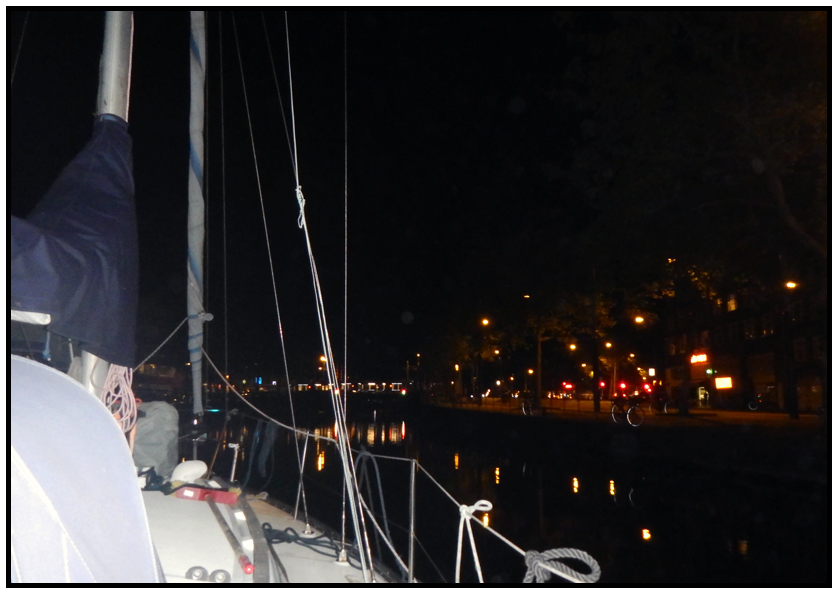
It was almost new moon, and when we left the lock it was pitch dark. Later on when we entered the inner city it became a lot brighter with all the street lighting, neon signs and illuminated windows. Slowly our nervosity subsided. It was actually all rather exiting. We were very much focused not to hit anything in the dark like the aforementioned submerged bicycles and to time our arrival at the bridges, but all in all we were able to enjoy the passage. Turned out the whole convoy was just us, and the bridges were operated remotely, so all alone we went through the dark canals of Amsterdam.
The nightly passage through Amsterdam
The 14th bridge was another rail bridge. We were supposed to hear the exact time of passage over the VHF, but there was only silence. After 15 minutes we hailed them, and were told that an opening would be arranged shortly. Shortly in Amsterdam apparently means something else than in the rest of the world, because we had to wait for another 20 minutes before the bridge opened.
One last bridge and then we entered the IJ canal, a broad water channel connecting the North Sea with the IJsselmeer. The marina where we were heading was on the other side of the canal, slightly to the left. Leaving all the bright city lights behind us, it became pitch dark again. There was a near miss with a lock pilar in the dark, and we had to maneuver around big wooden dolphins (sort of docking blocks sticking out the water). Normally they have white caps, but these didn’t, rendering them virtually invisible in the dark.
The IJ canal luckily wasn’t busy at all. We saw one other vessel in the distance, so we could safely cross to the other side and enter the marina.
It wasn’t long before we were safely moored in Amsterdam marina. But it took a while before we could sleep with all the excitement of completing our first night passage.