The municipality marina was supposed to have a washing machine, but since all the facilities are spread over the three locations, it took a while before we found out where it was. There was only one machine which was already in use. Bummer. It was also quite far away from our boat so walking back and forth with two batches of laundry would be really cumbersome. The washing program had just started, and since we had to wait for an hour anyway we went in search for a launderette. After a quick internet search we found one nearby, but when we got there it turned out it indeed used to be a launderette, but was now a lifestyle shop called ‘t oude Washhuys (washhuys is old Dutch for launderette). There was one other option though. The Compagnieshaven, which is the commercial marina, was just on the other side of the street from where our berth in the Oosterhaven was. We saw on the internet that they also had laundry facilities, and decided to try our luck there. And yes! Four big washing machines and two dryers, all empty. We got our laundry, bought the necessary tokens at their marina office, put our stuff in the washing machine and took a shower while we waited. We felt a bit like stowaways, but clean ones, fully refreshed and with clean clothes.
Thanks to a disgruntled Captain Fluffy, who was angrily jumping off and on the bed to growl at birds hopping on the deck we woke up early. We decided to make use of the early start and go to the Zuiderzee museum, an open air museum here in Enkhuizen dedicated to the history of arts and crafts of the former Zuiderzee. We were so early that the museum was just opening and we were the first ones to enter.
What is now known as the IJsselmeer used to be called the Zuiderzee. It was a big inner sea with an open connection with the Wadden and the North sea. Many cities and towns around the former Zuiderzee relied on fishing and trades connected to the fishing industry like basket weaving, coopery and smoke houses before it got closed of by the ‘Afsluitdijk’, one of the Deltaworks. After the Afsluitdijk was closed, a lot of these trades disappeared.
The historical ship yard
The many volunteers and professionals that work here are involved in living archaeology. By recreating historical artefacts they try to figure out how they used to be made, because a lot of knowledge has been lost even though it has only been less than a hundred years ago that people were living like this. Sometimes they try to recreate artefacts from historical paintings, which can be difficult because a painter allows himself artistic freedom in altering reality to better the painting. Some artefacts turn out to be Esther like objects, that can’t exist in reality. A friend of ours who recreates historical costumes for movies also had to recreate dresses that were impossible to make or wear because the painter had left out the creases and folds, probably because it looks better. Apart from the paintings, artifacts that have survived the test of time or slivers of knowledge that have been passed on somehow, there actually isn’t much to go on. The cooper that works here at the museum is one of the last professional coopers in The Netherlands and the sailmakers are still trying to figure out how the traditional water repellent fishing clothes were made and prepared. It is actually a bit unsettling to realize how fast knowledge disappears.
A watertight linen bucket
We love these open air historical musea, and spend the whole day chatting with the craftsmen and exploring the buildings, and we even had a crash course on how to knit fishing nets. The day was over before we knew it. We might have been the first to arrive, but we were the last to leave.
The weather forecast predicted 3 to 4 Beaufort for today and blowing straight towards Enkhuizen, so we decided to leave. We left the marina and hoisted our genoa first to see what the wind would do. It started out fine, we had a steady breeze and made good speed. But then the wind started to increase rapidly and soon it was blowing a steady 4 to 5 Beaufort. Our genoa is really big, and since it is probably one of the original sails it would be 40 years old, just as old as our boat is. After all these years it has completely lost its shape. It would only blow up like a balloon, trapping the air flow and tilting the boat over forwards which was not really pleasant. And since we’re not very experienced yet, we don’t know how to handle the ever increasing wind with the shapeless sail. We tried furling in the genoa a bit to minimize the amount sail, but that didn’t really change much. After the wind had increased even more with gusts up to 36 knots we had enough and decided to furl in the genoa and continue by engine. So much for 3 to 4 Beaufort.
Jeroen looking anxiously at the waves behind us
We were in for a bumpy ride. We were already halfway the Markermeer and the waves had time to build up on the open water, resulting in short but relatively big waves. The waves were sometimes even crashing into the cockpit from behind.
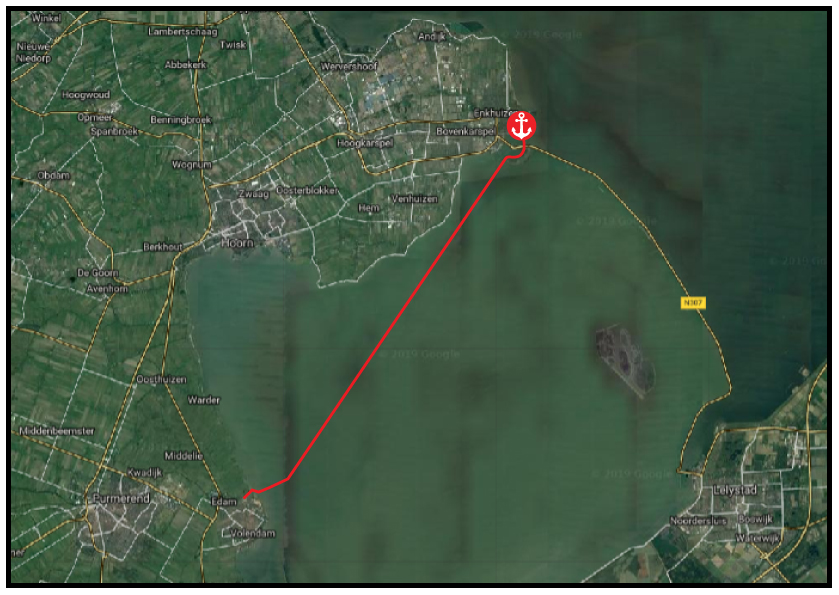
After being tossed hither and thither for almost 4 hours we finally reached the lock where we could exit the Markermeer and enter the IJsselmeer, also marking our destination. The marina of Enkhuizen lies right behind the lock.
No shortage on marinas here in Enkhuizen. There is a big municipality marina spread over three locations in the inner city. There is a also club marina near the train station and a huge commercial marina. Enkhuizen must be a popular spot since all the marinas were already quite full, and it isn’t even mid season yet. We chose to moor in the Oosterhaven, one of the three the municipality marinas.
After we had left the locks we hailed the harbour master who directed us to slip nr.66 in the Oosterhaven. Upon arrival it looked quite narrow, but since the harbour master had directed us to that slip knowing our width, we must assume that it will fit. But it didn’t. We entered slip but got stuck one third in. It was way too narrow. With some effort we prised ourselves loose, moored temporarily on the opposite side of the canal and hailed him again over VHF to say it didn’t fit. “Impossible!” he said “The slip should be almost 4 meters wide!”. We assured him that it really wasn’t, since we were 3,20 meters wide. He couldn’t appoint another slip immediately, since he was on his bike opening bridges and all, and had forgotten to bring the list. So if we could stay afloat for a while he would race to the harbour office and check for available spaces and hail us again. In the meantime we had seen that slip 55 was empty, looked broad enough and had a finger dock thus we suggested to dock there. The harbour master agreed, so we started the engine again and docked in slip 55. Or so we thought. When we were fastening the mooring lines we saw that it wasn’t 55 but 51. Wrong slip! We didn’t feel like relocating after the rough trip, so we hailed the harbour master again and told them that we had docked in the wrong slip. “My bad” I said, “ I wasn’t wearing my glasses”. Fortunately it wasn’t a problem to stay here. We were relieved to be done with it all.
We went to the harbour office to pay. In Enkhuizen paying for a slip is fully automated. Another first today, paying at a ticket machine. The machine printed a sticker we had to attach to the boat. We also had to buy a card from the machine to pay for electricity, water and showers.
After the usual post-mooring stuff like connecting shore power, cleaning up sail gear and reverse the saloon into living mode again we settled down in the cockpit to recover from the bumpy ride. The weather was cooperative for once. The wind had died down and there was even a ray of sunshine peeping through the clouds. Captain Fluffy didn’t need to recover from the passage. Although he had spent the whole trip in the V-berth, he almost immediately jumped on the finger dock and went off exploring. It looks like he already feels at home here.
Time to get some work done and prepare for the next passage. We had initially planned to go to the Markerwadden, but the weather isn’t looking good the coming week.
Another thing that slightly worries us is the enormous amounts of Pond weed here in the Markermeer. We mentioned it before, it is a water plant with really tough stringy stems. The Markermeer was intended to become a polder, to create more land for agriculture and housing. But shortly after they had started building, the idea was abandoned. The only thing they had build so far was a dyke to form the contour of the land. They left it in place, and now a road runs over it from Flevoland to Enkhuizen. But due to the dyke the water flow has been altered and the water gets muddier. With all the mud particles floating around sunlight has trouble to penetrate the water and the fish and water plants slowly die out, except for this particular Pond weed. Somehow this plant seems to thrive in these conditions. Every year the water gets muddier and the pond weed grows more excessively. As a counter measure Rijkswaterstaat (governmental organization in charge of infrastructure) is constructing the Markerwadden, artificial islands in the Markermeer that have the purpose to collect the suspended clay particles and clarify the water. But that will take a while.
For now the pond weed is still going strong and causing a lot of grief. Because of the massive growth a lot of boats get the stringy stems of the weed entangled in their prop, rendering them immobile. Some individuals take advantage of that. We were warned by people in the marina only to accept help from the coast guard if you’re in trouble. Otherwise kindly decline any offers for help. What happens is that these individuals conveniently pop up when you’re in trouble and offer to tow you back to a marina. They make it look like they are accidentally in the vicinity, but in reality they are salvage companies waiting in areas with excessive pondweed growth. So the minute you accept their help, or accept a rope being thrown at you, they’ll send you a cheque of €5000,-.
We don’t want to get the nasty stuff in our prop and having to dive under the boat to cut away the pond weed or to ward of pushy salvage people, therefore we want to leave the Markermeer as soon as possible.
So no Markerwadden, maybe next year in early spring when the pond weed isn’t that much of a problem yet. The plan is now to go to Enkhuizen. Let’s see what the weather does tomorrow.
Captain Fluffy finally tired of running and enjoying a bit of shade
A beautiful sunny day. We would have loved to lounge in the cockpit the whole day, but we needed to get some groceries. So we hoisted our backpacks and set of for the supermarket.
Captain Fluffy wasn’t as lazy as we were today. When we got back from our shopping errand he sprinted outside and was running around in the grass like a maniac. Normally he stays within a 10 meter radius, but today he was so adventurous that we had to put him on a leash. Not at all bothered by the leash he dashed away, hopping from one sprig of grass to another like an overgrown and hairy butterfly. After an hour of jumping through the grass Captain Fluffy was finally getting tired, and trotted back to the boat. Satisfied he curled up in the cockpit and we all enjoyed the afternoon sun together.
The weird thing about traveling and still not having left the country is that somehow ‘normal’ life gets interwoven with your journey and that -if necessary- you can travel back for things like the dentist last week. Today there was another event worth travelling back for. Jos de Haas from Jachtwerf de Haas was going to receive a Royal decoration today, but it’s quite an undertaking to get to the wharf by public transport from the marina in Edam. But our friend Job was so kind to come and collect us, so early in the morning we drove to The Hague together. The conspirators Paul, Henk and Willem who had recommended that Jos should be honored with a Royal decoration, had kept the whole ordeal secret, so Jos was oblivious to the fact that dozens of family members, friends, acquaintances and customers had gathered in the wharf to surprise him. It was heartwarming to see how many people have been touched by his kindness and were here to celebrate this moment with him and many had generously helped to organize the event, provide for food or drinks and music.
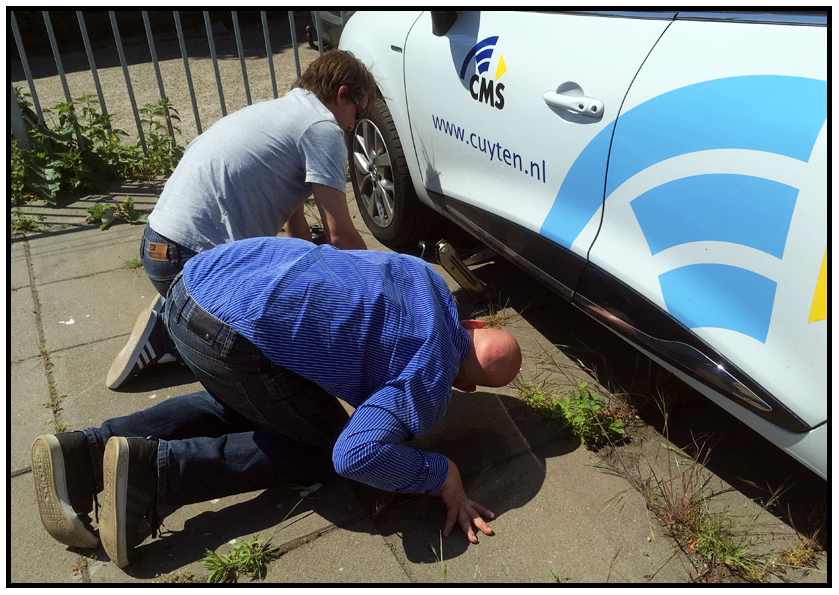
When the festivities were coming to an end we thought it was time to go back to Edam. But to our surprise the car had a flat tire. It had felt like we had hit a bump when we entered The Hague earlier, but when we arrived at the wharf it looked perfectly okay. But obviously it wasn’t.
Modern cars don’t have spare tires anymore, but they come equipped with a sort of foam that you have to inject in the tire. The foam expands inside the tire and should seal the hole, provided it isn’t too big. But the hole in this tire was way too big, more of a tear than a hole. When we pumped in the foam you heard the hissing sound of the air escaping again. The only thing left to do was to call roadside assistance. They had to go to the depot to get a new tire first, but after 2 hours a new tire was mounted and we were finally on our way back to Edam again.
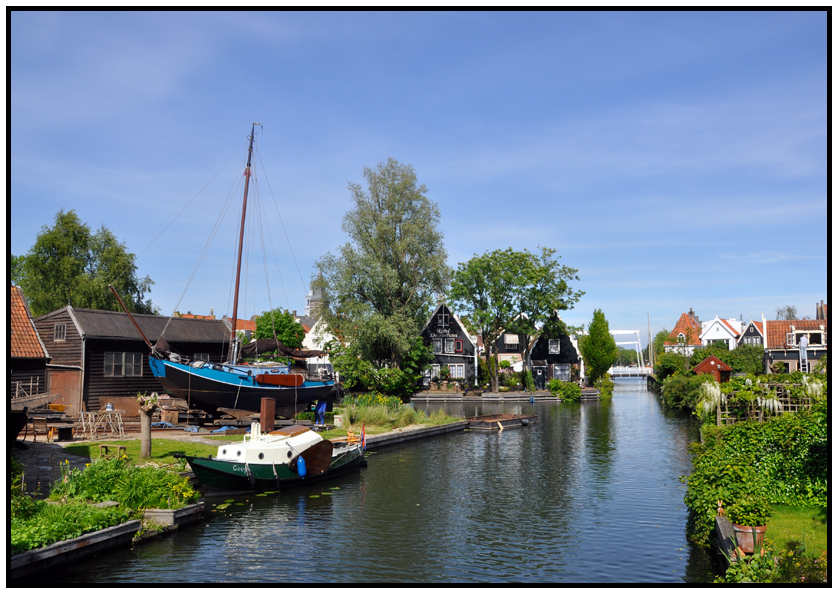
The still operational shipyard in the middle of the old town
Captain Fluffy was in an adventurous mood today. Normally he doesn’t leave the boat if there isn’t a finger dock, but now he had discovered that another boat functions perfectly well as finger dock. Within the blink of an eye he was up and over the neighbouring boat and frolicking about in the grass.
After Captain Fluffy had his fun we did a bit of exploring ourselves and set out to the historic centre of Edam. Edam is a beautiful little city. If it wasn’t for the cars parked here and there it could have been an open air museum. Funny, we’ve been to several historical towns and cities so far, but somehow this one looked more real. Most buildings date from the 17th century and there’s even an old shipyard that is still in use in the middle of the town. We like it here. It’s a friendly town, people are smiling and relaxed. And even though there are quite a few tourists about it doesn’t feel like a touristic place. We enjoyed the scenery and the people passing by whilst enjoying an ice cream in the sunshine. Life is good.
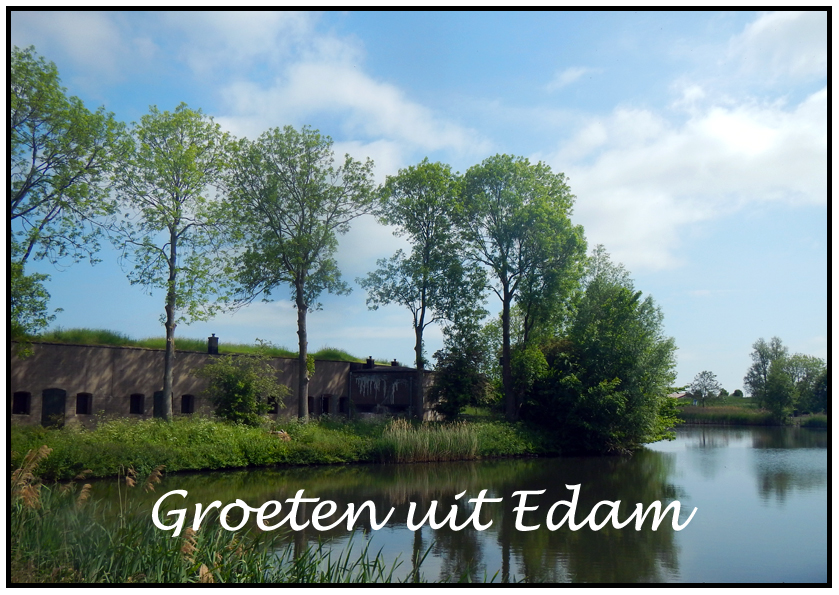
According to the map there should be an old fortress on the other side of the canal. We thought it might be worth a visit and set out to explore. Fort Edam, as it is called, turned out to be a fortress built at the end of the 19th century as part of the defence line of Amsterdam, a defensive circle of 46 forts and batteries around the capital. The Dutch have always resorted to inundating the land as a defensive measure. And in the past it had worked, for instance against the Spanish army, but that was when armies attacked each other on horseback and dragged heavy cannons with them. Unfortunately they hadn’t heard of airplanes yet when they designed the defensive line in 1880, so after its completion in 1914 it was already outdated.
You might think that we had learned something from this miscalculation, but no. In 1951 the Dutch, still clinging onto the idea of inundation, built the IJssellinie, a line of defence 120 kilometre in length in the east of the Netherlands. Its purpose was to keep out the Russians. Inundation hadn’t worked against airplanes, but who knows, maybe it will work against nuclear missiles! Really, sometimes it is just time to think of something new and kill your darlings.
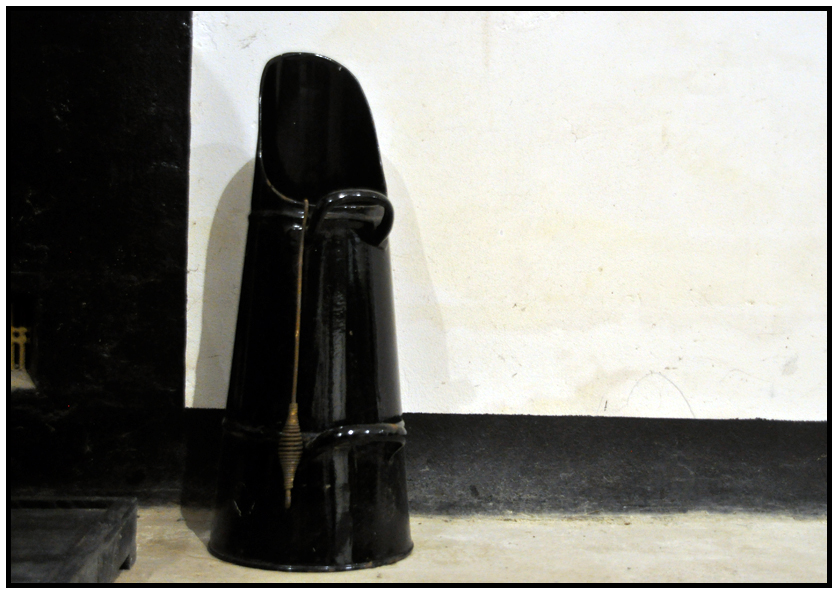
One of the artefacts
We joined a tour guide just about to start his tour with a small group. He asked if we all just wanted to hear the highlights or do the full tour, which we all chose. Little did we know that the full tour was a 3 hour long experience in which the story behind every bolt and stone in the fort was revealed in a very enthusiastic and detailed way. The volunteers who run the museum evidently have a lot of love for their work, and are keen to share their knowledge. So when three hours later we emerged in daylight again, we knew all there is to know about Fort Edam. Living there must have been terrible because after just three hours we were chilled to the bone, and needed lots of warm tea to thaw again. While defrosting outside in the sunshine the helpful volunteers were eager to give us advice on what to visit next, and swamped us with brochures and coupons.
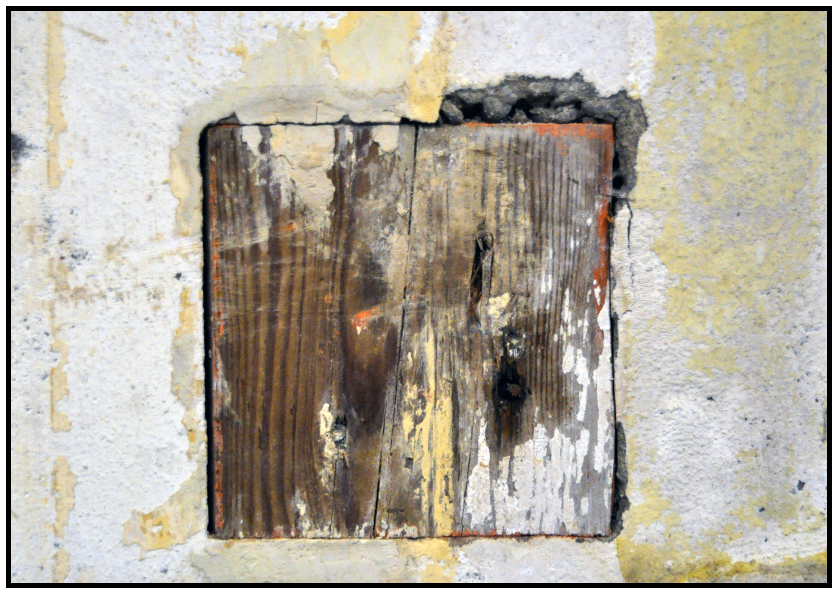
The walls were too tough for hand drills, so they incorporated wooden blocks in the wall to fasten things on
Our heads still buzzing with historical facts and pockets full with brochures we went back to our boat to further defrost in the sunshine.
The weather had indeed changed. The wind had picked up significantly, but fortunately no rain. After all the fuss with the anchor alarm we finally had a good night’s sleep. The harbour master came to check on the electricity, and after some fidgeting we finally had power. All was well with the world again.
It was high time for a trip to a grocery store. Armed with backpacks to carry our groceries we set off to the nearest supermarket. On our way there we saw a peculiar sight. A Pheasant was being attacked at the same time by both an Oystercatcher and a Moorhen. The Oystercatcher kept pelting down on the Pheasant, every time pecking him hard on the head, whilst the Moorhen was attacking him from below, screaming like a banshee. The Pheasant must have caused some serious grieve to be harassed like that.
While standing there on the dyke watching the spectacle, a women with a camera stopped to watch as well and we started talking. She used to work as a self-employed neurotherapist, but decided to end her practice, move to a smaller house and see something of the world. Like us she had downsized significantly when she moved to the smaller house and experienced that you really don’t need so much stuff. The change allowed her to save money to travel and she had just returned from a long trip to Vietnam. Now she was trying to organize her life in such a way that she could become a perpetual traveler. It’s remarkable when you’re traveling for an extended period like we are now, that you meet so many like minded people, almost as if you’re attracting them. Her explanation for these chance encounters was as simple as true: “We are the only ones standing still while everybody else is rushing past”.
The weather is changing and the barometer is plummeting like a rock. Time to move today because tomorrow the wind is going to increase even more and it will start to rain. Despite our worries of the last days our anchor had set well. We could tell it had dug in really deep, because when the last shackles and the anchor surfaced it was covered in such a thick layer of clay that we could provide for a whole pottery.
We had also dragged up pieces of pond weed (Potamogeton), common water plants for this area that in summer grow so fast that the authorities need to mow them to enable boats to move. But it is still springtime so hopefully the growth isn’t that severe yet. As the plants appear to be edible we probably need to graze our way through the Markermeer in summertime.
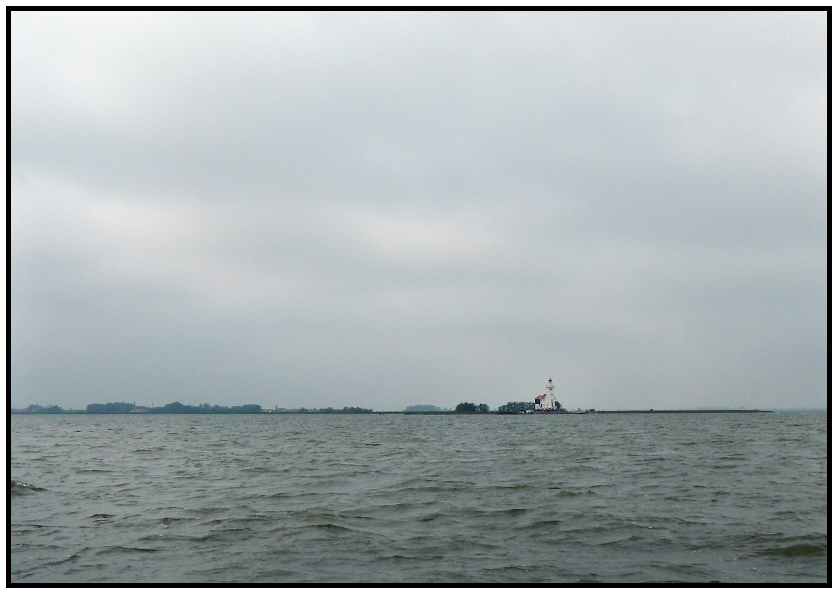
The Horse of Marken in the distance
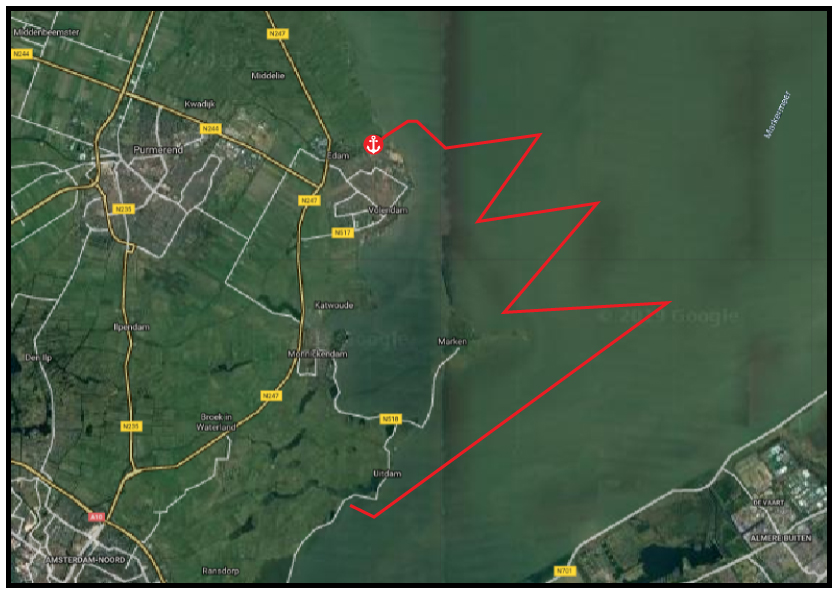
The wind was perfect for sailing, thus after hauling in the anchor we hoisted all the sails and headed towards Edam. We made good speed, and soon rounded the Horse of Marken, a historic lighthouse built in 1839 on the former island. Although heavily overcast, it was quite an enjoyable sail. Later in the afternoon the wind started to increase steadily, and before long it had increased to wind force 4 with gusts of 5 and was still increasing. All the other sailboats were heading towards shore, and soon we were the only boat left on the water. But we were already approaching the entrance to the marina of Edam, so we took down the sails and traversed the last bit by engine.
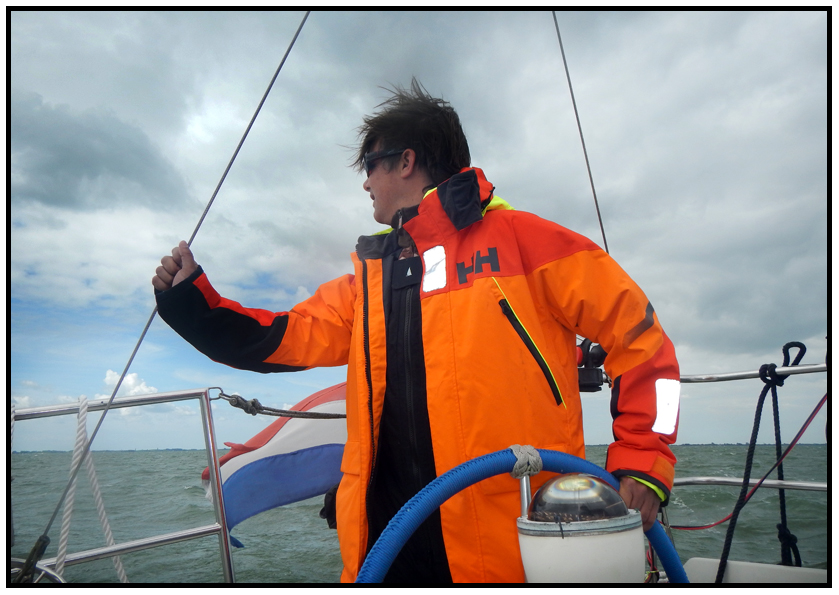
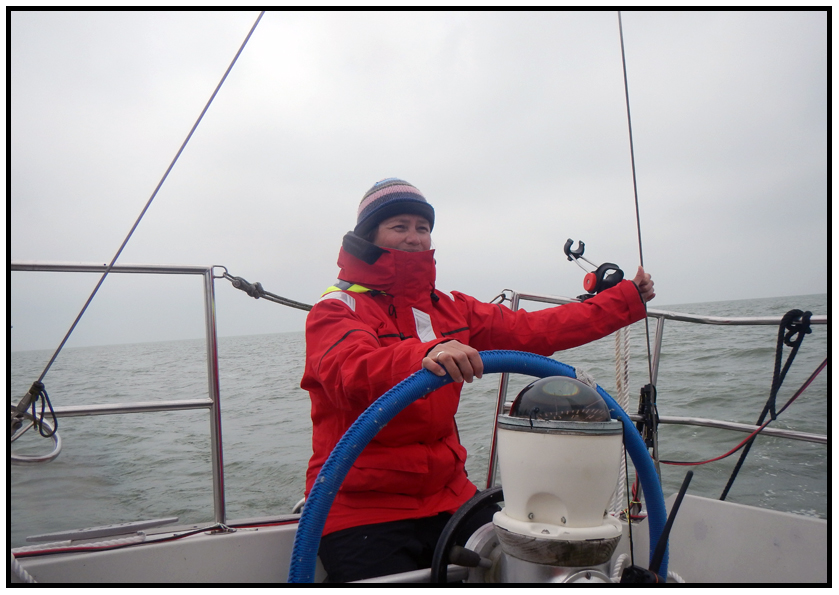
Carmen at the helm
The harbour entrance was a bit shallow for our draft, but we docked in the marina of W.S.V. De Zeevang without difficulties. What proved to be difficult was getting electricity. Just like in Leiden, there are poles with sockets in which you have to insert €0,50 to get electricity. But after trying two sockets and loosing 2 coins we decided that this is a problem for tomorrow.