
April 26th 2019
The sun was out again, time to leave.
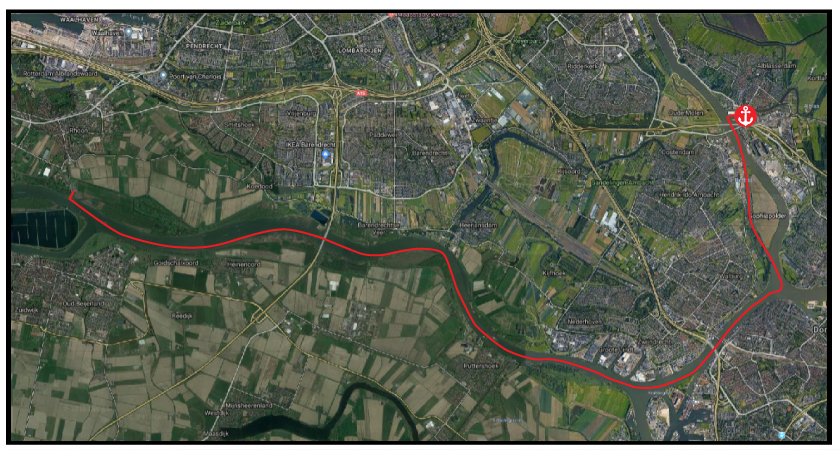
But first we had to figure out what the deal was again with currents and tides and such, because the next part of our journey takes us over the ‘Oude Maas’, a tidal river busy with shipping traffic. We have a tidal map, with little arrows that indicate the direction of the current in a specific tidal phase (f.i. 4 hours after high tide) in relation to a place on the map like Den Helder for instance. Okay, we still get that, sort of. But here comes the difficult part. How to determine the direction of the current at high tide at other places that aren’t mapped? No one from the hive mind was able to explain it in simple terms, so we just tried our luck and left at 11 in the morning.
Fortune was smiling at us because the Oude Maas wasn’t too busy, and we had the tide with us. The river took us through beautiful landscapes and nature reserves. The twittering of birds was sometimes louder than the sound of our engine. And then suddenly nature gave way for heavy industry and the traffic was accumulating, a sign that we were approaching the crossing Oude Maas/ Dortse Kil, one of the busiest inland crossings in Europe.
The busy inland waterways are divided into areas controlled by an area coordinator and designated VHF channels. Normally in the Netherlands if you are a pleasure craft smaller than 20 meters, you don’t have to notify the area coordinator that you are entering their area. But since this area is so busy with big container ships and sea going traffic, the coordinators tend to get really pissed off if you start crossing channels without letting them know. And since we already heard the area coordinator and some of the large vessels complain about ‘those small yachts that just do whatever’ we compliantly announced our intentions to go left in the direction of Dordrecht. He didn’t sound too happy with our notification. Maybe he was already getting worked up about ‘yet another unpredictable small yacht that isn’t going to notify us, you’ll see’, and then we did. What to do now with all that pent up aggression? Grumpily we were warned for a huge seagoing container ship behind us, that wanted to go right to the Dortse Kil. Pleasure crafts have to keep to starboard as much as possible, and the container ship was way faster than us so we had to hold in and let him go first. After that the grumpy sector coordinator told us we had permission to cross, but quickly (grumble grumble…).
Right after the crossing we had to pass two bridges at Dordrecht. They are railroad bridges with exact opening times and have a narrow time window before they close again due to the international trains that run over them. We were lucky again and arrived just under 10 minutes before it opened, which was very convenient because with all the traffic on the water in felt like being in a washing machine.
Once we crossed the bridge we passed the old town of Dordrecht. Initially we had planned to spend the night here, but we decided to sail on. Partly because it was still quite early so we could cover more miles, but mainly because tomorrow is Kings’ day, a national holiday to celebrate the Kings’ birthday. Dordrecht is quite a big city for Dutch standards and the marina we were initially heading for is right in the center of the city amidst all the bars and cafes, so it could become rather noisy and unpleasant.
So we sailed on and approached another bridge we had to cross at Alblasserdam. We tried to hail the bridge and ask for an opening via VHF, but no response. There was nothing to be found on the internet about opening times or a phone number, so we had no idea how long we had to wait. After 10 minutes of continuous attempts to hail them they finally responded. Most of these bridges are remotely controlled, so they were probably not on watch yet. We had to wait for another 20 minutes before we could pass, and without a mooring spot to wait we had to motor in circles to pass the time.
Directly after bridge lies the entrance to the marina of Alblasserdam. Since it was now half past three in the afternoon, we decided to stop here and wait for the bad weather front with heavy rainfall to pass. It was forecasted to start at the end of the afternoon and pass over in two days. While we waited for the bridge to open we tried to call the marina, but maybe it’s a thing in this town, because they didn’t respond as well. We tried our luck again and went in anyway.
We needed to pass another bridge to get to the town centre where the marina of W.S.V d’Alblasserwaerdt lies. In order to pass we needed to hail the bridge master who came racing to the bridge on her bike to open it just for us. It was a very small club run marina with only one or two empty slips, but two berth holders kindly helped us to navigate towards one of them and to dock the boat.
The harbour master arrived later and gave us the key to the gate and the sanitary building. We’ve noticed that a lot of small marinas which are run by clubs and volunteers don’t have a dedicated harbour master, just someone who does it next to his or her normal daytime job. That explains the tardiness in response.
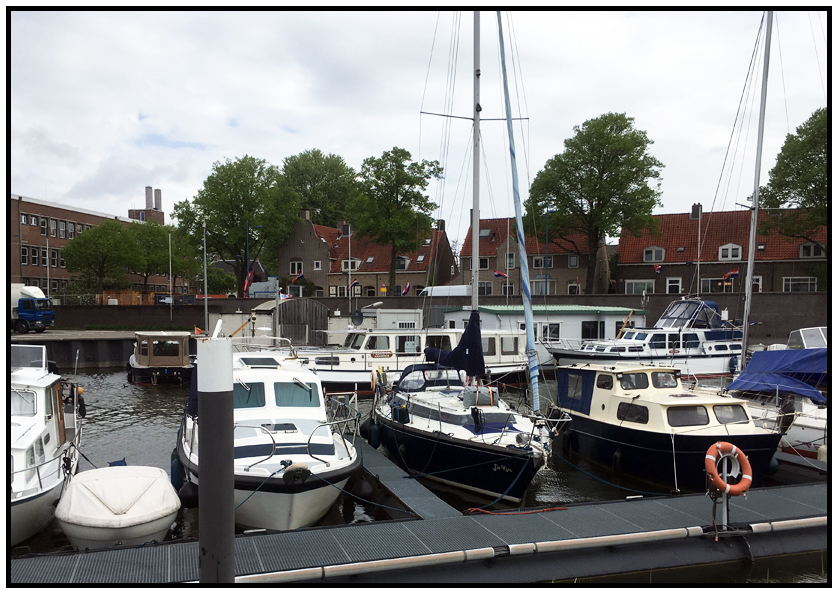
We ventured into town to get some groceries and relaxed a bit afterwards with nibblies in the cockpit before the rain came.